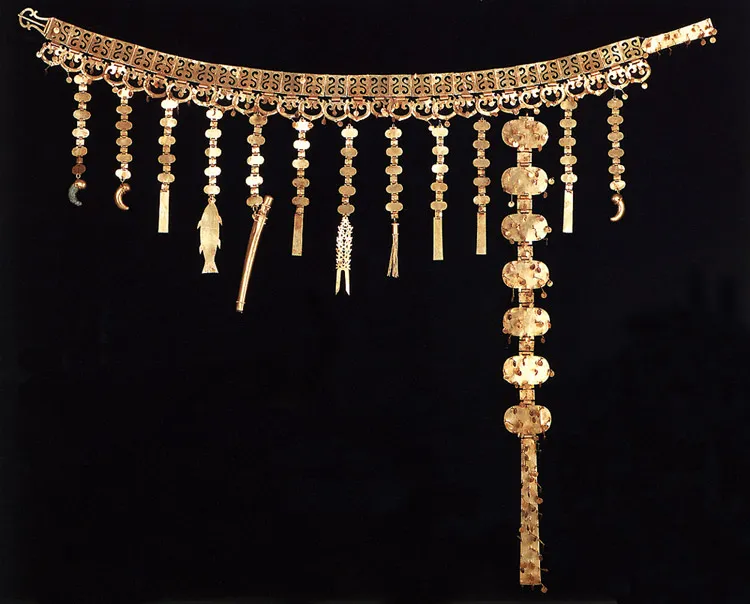
Gold Waist Belt from the North Mound of Hwangnamdaechong Tomb
皇南大塚 北墳 金製 銙帶
서울특별시 용산구
Basic information
- Designation
- National Treasure No.192
- Category
- Craft
- Era
- 신라시대
- Designated year
- 1978
- Location
- 용산구, 서울특별시— 서울특별시 용산구 서빙고로 137 (용산동6가, 국립중앙박물관)
- Coordinates
- 37.524041, 126.980350
AI Docent
Coming soonAn AI-generated, friendly retelling of this heritage site is available in Korean. An English version is on our roadmap — for now, please see the official description below.
Description
A belt made of cloth is called gwadae. Attached to the belt are rectangular forms made of metal. This Korean gwadae influenced by China is decorated with valuable objects such as jadeite and commodities such as a small knife, a case for drugs, a whetstone, a flint and tweezers. According to lessons of formality called Yegi from China, when descendants performed the ancestral rites, on the left side of the belt there should be a towel, a grindstone, a small cup and an iron flint. On the right side are a set of bone instruments called gyeol (worn on the thumb and used in archery), an instrument called gwan which is used to suspend strings on a bow (in archery) and a large cup. The color, number and material of it represented the wearer's government posts in the Baekje and Silla Dynasty. Exhumed from the North Tomb of Hwangnam-dong, Gyeongju-si, Gyeongsangbuk-do Province, a golden belt is 120cm in length and yopae which is worn with the gwadae, is 22.5-73.5cm in length. This belt consists of 28 links. There are small holes around the edge of the leather belt. The 13 yopae hangs from the base of the belt connected by a hinge. The yopae are considered valuable for research for they determine how the belt was worn and used. Hwangnamdaechong is located at the ancient tomb park of the Michuwangneung Royal Tomb District (Silla Dynasty). Its serial number is 98, and was one of Silla's tombs before the Unified Silla Era. It was named to Hwangnamdaechong (Hwangnam great tomb) since it has been excavated two times, once in 1973 and again in 1975. East to west, the tomb is 80m in diameter and 120m in diameter from south to north. The height of its southern entrance is 23m and its northern entrance is 22m in height. The overall formation is in the form of a gourd dipper as shown by the connection of the two round shapes going north and south. This is the largest tomb made during the Silla Dynasty which features clay on the outside and stone.
Location
지도를 불러오는 중…
Have you visited this place?
Log in and verify your visit on-site via GPS to record a stamp in My Journey. (QR verification coming later.)
Images: KOGL (khs.go.kr) · Data source: Korea Heritage Service Open API (khs.go.kr)