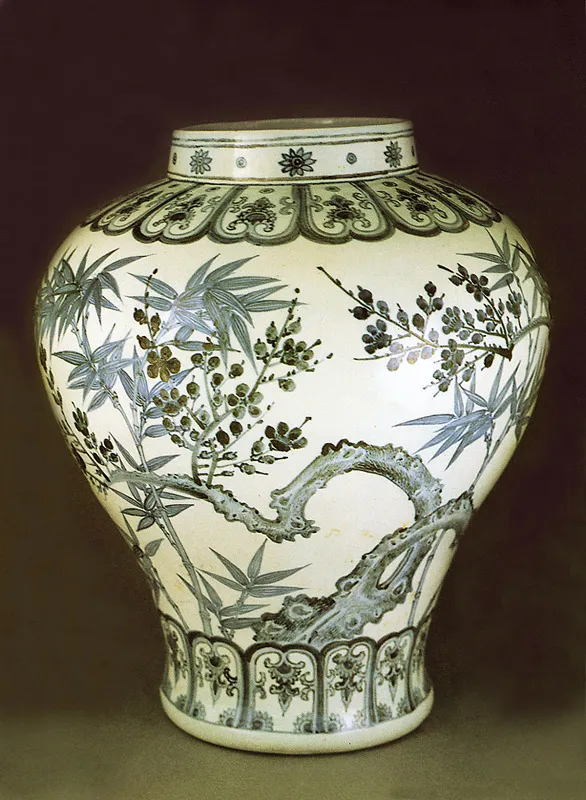
White Porcelain Jar with Plum and Bamboo Design in Underglaze Cobalt Blue
白磁 靑畵梅竹文 立壺
서울특별시 용산구
Basic information
- Designation
- National Treasure No.219
- Category
- Craft
- Era
- 조선시대(15세기)
- Designated year
- 1984
- Location
- 용산구, 서울특별시— 서울 용산구 이태원로55길 60-16, 삼성미술관 리움 (한남동)
- Coordinates
- 37.536528, 126.996187
AI Docent
Coming soonAn AI-generated, friendly retelling of this heritage site is available in Korean. An English version is on our roadmap — for now, please see the official description below.
Description
This is a white jar produced during the early years of the Joseon Dynasty. Slightly light blue in color, the jar is 41cm tall, 15.7cm in diameter at top and 18.2cm on the bottom. Some of of its characteristics include: 1. Appearance: It narrows a little inwardly at the lip and the upper part of the body is convex though it becomes narrower and widens a bit in the lower half. 2. Patterns: On the lip, there are two horizontal lines, then alternating flowers and double rings just below it, then one horizontal line again. On the shoulder is a very brilliantly and ornamentally painted lotus. On the body, there are plums and bamboos in great detail; the former pictured with crossing branches and the latter with delicacy. 3. Skill: The outline was sketched first, and then painted carefully. This process is called gureukjinchaebeop, intending to create realism in pictures. According to experts, the patterns on the body, deftness, color, and shape, are influenced by the white jars with soft blue manufactured during the Ming Dynasty in China. This jar is regarded as being the first attempt at Cheonghwabaekja (a jar with blue-and-white color) produced at Gwangju, Gyeonggi-do (center of the Korean Peninsula) in the middle of the 15th century.
Location
지도를 불러오는 중…
Have you visited this place?
Log in and verify your visit on-site via GPS to record a stamp in My Journey. (QR verification coming later.)
Images: KOGL (khs.go.kr) · Data source: Korea Heritage Service Open API (khs.go.kr)