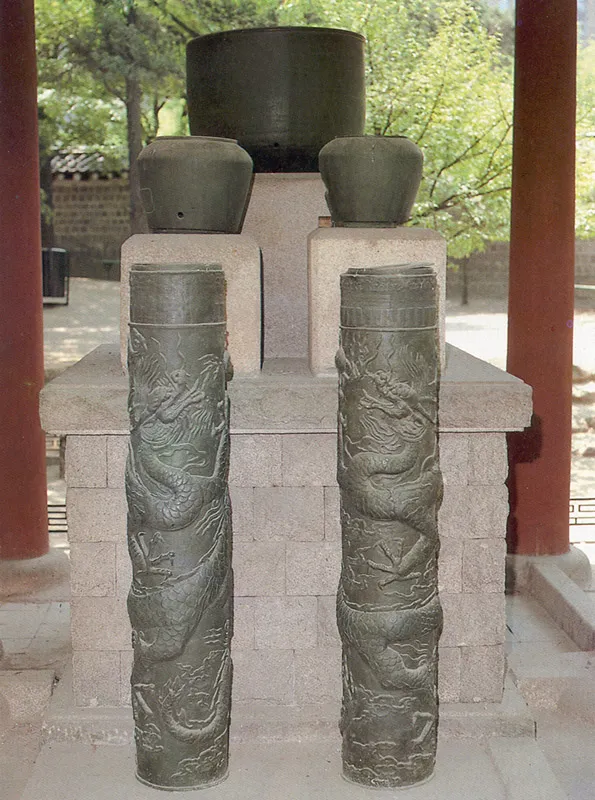
Clepsydra of Changgyeonggung Palace
昌慶宮 自擊漏 漏器
서울특별시 종로구
Basic information
- Designation
- National Treasure No.229
- Category
- Craft
- Era
- 조선 중종 31년(1536)
- Designated year
- 1985
- Location
- 종로구, 서울특별시— 서울특별시 종로구 효자로 12 (세종로, 국립고궁박물관)
- Coordinates
- 37.565897, 126.975022
AI Docent
Coming soonAn AI-generated, friendly retelling of this heritage site is available in Korean. An English version is on our roadmap — for now, please see the official description below.
Description
The water clock was used for standard hours since the Three Kingdoms Period. Jagyeongnu, made in 1434 during the reign of King Sejong of Joseon, was the first water clock that was devised to strike the hour automatically with a bell, gong or drum. However, as it had not been properly preserved, King Jungjong had it remade in 1536, of which only some parts remain to the present. The bronze receptacle is 93.5cm in diameter and 70.0cm in height. The smaller ceramic vessel is 46.0cm in diameter and 40.5cm in height. Two pedestals for the latter still remain behind the Myeongjeongjeon Hall of Changgyeonggung Palace. The design of this water clock is as follows: The water poured into the upper largest vessel goes down via the smaller one into the long water tank. As the water level rises to the previously set position, a floating rod touches the lever device, which causes a bead at the other end to roll down to hit another bead. This bead, while rolling, triggers many devices to strike the gong, bell and drum or for a wooden puppet to lift up the time notice board. However, this no longer functions as only the vessel parts remain to this day. This water clock was made a little later than the one that had been made by the Ming Dynasty, China. Still, it is regarded very precious for its scale and elaborateness.
Location
지도를 불러오는 중…
Have you visited this place?
Log in and verify your visit on-site via GPS to record a stamp in My Journey. (QR verification coming later.)
Images: KOGL (khs.go.kr) · Data source: Korea Heritage Service Open API (khs.go.kr)