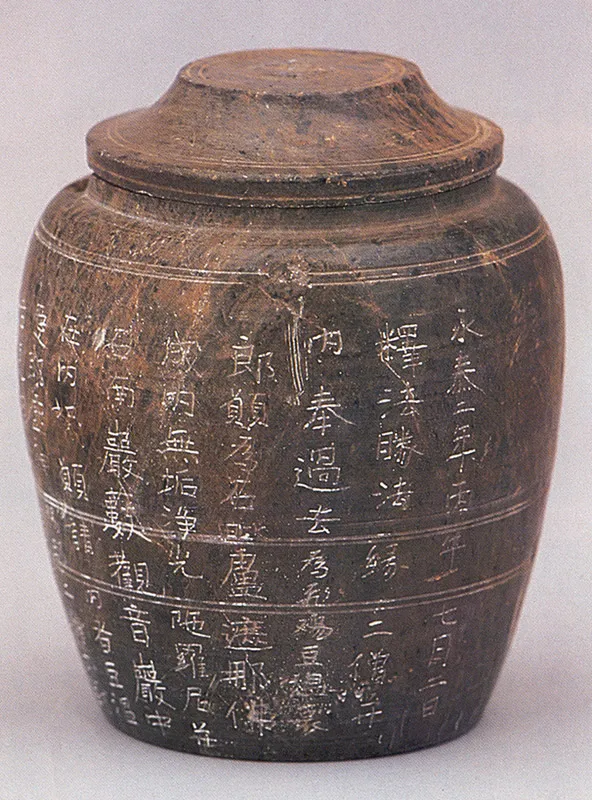
Agalmatolite Reliquary from the Stone Seated Vairocana Buddha from Seongnamamsa Temple Site, Sancheong
山淸 石南巖寺址 石造毘盧遮那佛坐像 滑石舍利壺
부산광역시 남구
Basic information
- Designation
- National Treasure No.233-2
- Category
- Craft
- Era
- 통일신라
- Designated year
- 1986
- Location
- 남구, 부산광역시— 부산 남구 유엔평화로 63, 부산시립박물관 (대연동,부산광역시시립박물관)
- Coordinates
- 35.129556, 129.092942Kakao address conversion
AI Docent
Coming soonAn AI-generated, friendly retelling of this heritage site is available in Korean. An English version is on our roadmap — for now, please see the official description below.
Description
Produced during the Unified Silla Era, this jar is made out of a darkish pencil stone. Its total height, including the lid, is 14.5cm. The height of the body (without the lid) is 12cm, 9cm in diameter on top and 8cm on the bottom. Discovered inside a support stone in the center of a stone Buddha, it has since then been in residence for months and years inside a monk's cell located in a rocky valley of Jirisan Mountain in Gyeongsangnam-do Province. Some of its features include: 1. Enclosing of a projection rather thick than the body around the mouth, a sense of stability from the flat and wide base of non-hoof. 2. Two horizontal lines carved just below the jar's muzzle, middle of the body, and midway between the middle of the body and the bottom. 3. On top of the lid are two lines that form a circle and in the inner center is an engraving of a lotus flower. On the image of the Vairocana Buddha, a record of the jar's production is inscribed. Written in 15 lines of verse, the record concretely says that the jar was made during the second year of Yeongtae, or the second year of King Hyegong's reign (A.D. 766). This inscription has contributed much to understanding when this jar was manufactured: the 8th century, much earlier than it was originally thought. Interpretation of the 15 lines of the verse is somewhat flexible for some of the carved letters were written irregularly. According to experts, though the inscription is difficult to read, the general understanding of the verses is that it was used to console the souls of the dead and promote prosperity and adversity to all mankind. Though a box with paper reduced to ashes (at the time of digging) was discovered, the Jar is regarded as the first discovery of a reliquary in a support stone of a Budda statue in Korea. Therefore, the Jar is regarded as precious historical evidence concerning the study of Buddhism and art history. For the former, it is based on lying in state of Sarira--the terms of its manufacture and its reasons. The latter is on the basis of the skills related to writing the letters, the technology used in manufacturing the lid, the materials used, and the overall work.
Location
지도를 불러오는 중…
Have you visited this place?
Log in and verify your visit on-site via GPS to record a stamp in My Journey. (QR verification coming later.)
Images: KOGL (khs.go.kr) · Data source: Korea Heritage Service Open API (khs.go.kr)