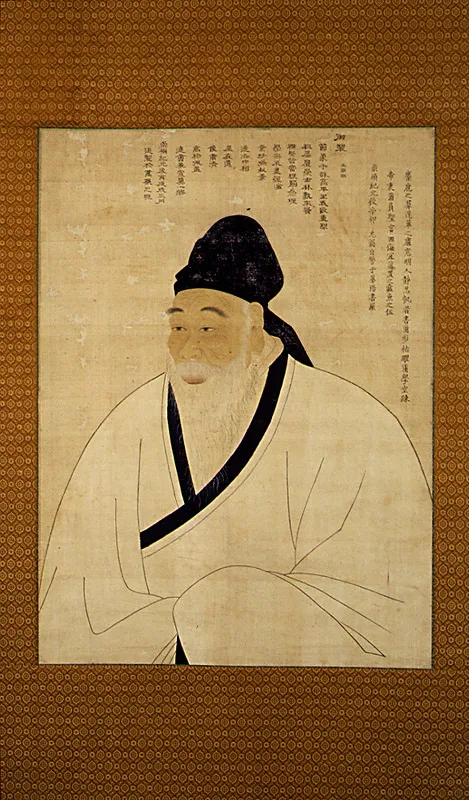
Portrait of Song Si-yeol
宋時烈 肖像
서울특별시 용산구
Basic information
- Designation
- National Treasure No.239
- Category
- Painting
- Era
- 조선 효종 2년(1651)
- Designated year
- 1987
- Location
- 용산구, 서울특별시— 서울특별시 용산구 서빙고로 137 (용산동6가, 국립중앙박물관)
- Coordinates
- 37.524041, 126.980350
AI Docent
Coming soonAn AI-generated, friendly retelling of this heritage site is available in Korean. An English version is on our roadmap — for now, please see the official description below.
Description
This is the portrait of Song Si-yeol (pen-name: Uam) (1607~1689), the representative Neo-Confucian scholar as well as a politician during the middle period of the Joseon Dynasty. As a disciple of Kim Jangsaeng, Song Si-yeol was a talented and prominent writer whose writing style was logical and vigorous. He devoted himself to the study of Chu Hsi and chose to be the successor of Yi I (pen-name: Yulgok; 1536~84) who emphasized the principle of the energizing element called gi, rather than Yi Hwang (pen-name: Toegye, 1501-70) who stressed the importance of the principle called I, which he believed governs human nature and behavior. After going through several government positions, he finally rose to the highest level of vice prime minister. However, after repeated rustication, reappointment, and exile, the saint, being involved in the fight of political faction, was bestowed unfair death-penalty poison from the king. This portrait of Song Si-yeol (56,5cm x 97cm) was drawn showing only upper half on silk fabrics, with the face turning right, dressed in ordinary clothes with broad sleeves that the Confucians used to wear. Wearing the black hood on his head, he maintains dignity with heavy mustache and long silver-gray bushy beard. Saint Song Si-yeol reveals a strong image as a scholar of his profound knowledge, with his emphasized massive figure, strong eye-brows, and deeply lined cheekbones. His face was painted in light color first, then the furrowed lines were drawn in brown, and the wrinkles of the clothes were expressed simply by the curved lines. On the right side, there is a comment with his writing and on the upper part, complimentary remarks made by King Jeongjo. After his death, many a shrine and Confucian Academy have been set up to look back upon the memory of him with respect and affection. Among 5-pieced works that still remain, this portrait is considered as the most valuable one.
Location
지도를 불러오는 중…
Have you visited this place?
Log in and verify your visit on-site via GPS to record a stamp in My Journey. (QR verification coming later.)
Images: KOGL (khs.go.kr) · Data source: Korea Heritage Service Open API (khs.go.kr)