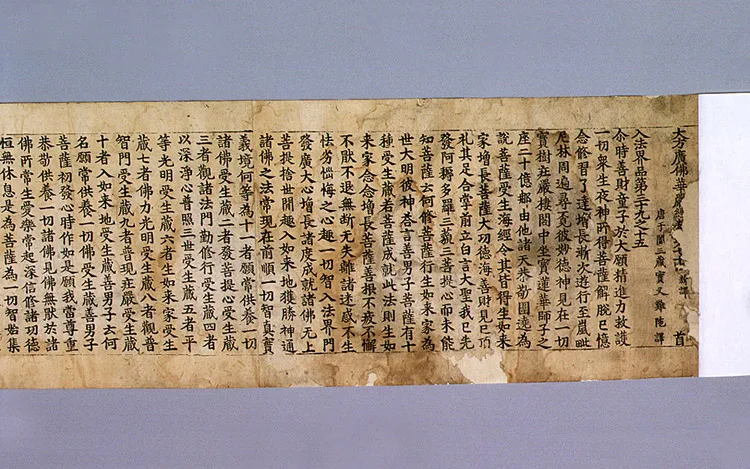
Avatamsaka Sutra (The Flower Garland Sutra), Zhou Version, the First Tripitaka Koreana Edition, Volume 74
初雕本 大方廣佛華嚴經 周本 卷七十四
충청북도 단양군
Basic information
- Designation
- National Treasure No.279
- Category
- Books & Records
- Era
- 11세기
- Designated year
- 1993
- Location
- 단양군, 충청북도— 충청북도 단양군 백자길 9 (영춘면, 대한불교천태종 불교천태중앙박물관)
- Coordinates
- 37.043564, 128.485169Kakao address conversion
AI Docent
Coming soonAn AI-generated, friendly retelling of this heritage site is available in Korean. An English version is on our roadmap — for now, please see the official description below.
Description
Also called Avatamsaka Sutra, Mahavajpulya-Buddha-Avatamsaka-Sutra contains the basic philosophy that Buddha and ordinary people are one. Together with Lotus Sutra, it is a basic sutra for the Huayan Sect (Avata-saka Sect) and one of the scriptures that have wielded the greatest influence on the establishment of Buddhist philosophy of Korea. This book is one of the First Tripitaka Koreana editions made to overcome the invasion of the Khitan with the help of Buddha during the reign of King Hyeongjong (r. 1011-1031) of Goryeo. As part of the 80-volume Zhou edition translated by Sik ananda of the Tang Dynasty of China, it (measuring 28.7㎝ by 46㎝) was woodblock-printed on mulberry paper made into a scroll. There are some differences between the First Tripitaka Koreana editions and those made later and kept at Haeinsa Temple. The former display an exquisite shape of letters of woodblock carving, but the number of characters carved on each line is different from that of the ones kept in Haeinsa. It contains no information as to when it was published. It shows the practice of omitting a stroke of a Chinese character identical to one of the characters used for the name of a king or using another character out of respect for the king. In indicating the unit of the number of sheets composing the sutra, the First Tripitaka Koreana editions use Chinese characters like “丈” or “幅.” The ones kept in Haeinsa use “張,” however, this one is believed to have been published between the 11th and 12th centuries like Vol. 1 (National Treasure No. 256), Vol. 29 (National Treasure No. 257), Vol. 13 (National Treasure No. 265), and Vol. 75 (National Treasure No. 266), judging from the status of printing and the quality of paper.
Location
지도를 불러오는 중…
Have you visited this place?
Log in and verify your visit on-site via GPS to record a stamp in My Journey. (QR verification coming later.)
Images: KOGL (khs.go.kr) · Data source: Korea Heritage Service Open API (khs.go.kr)