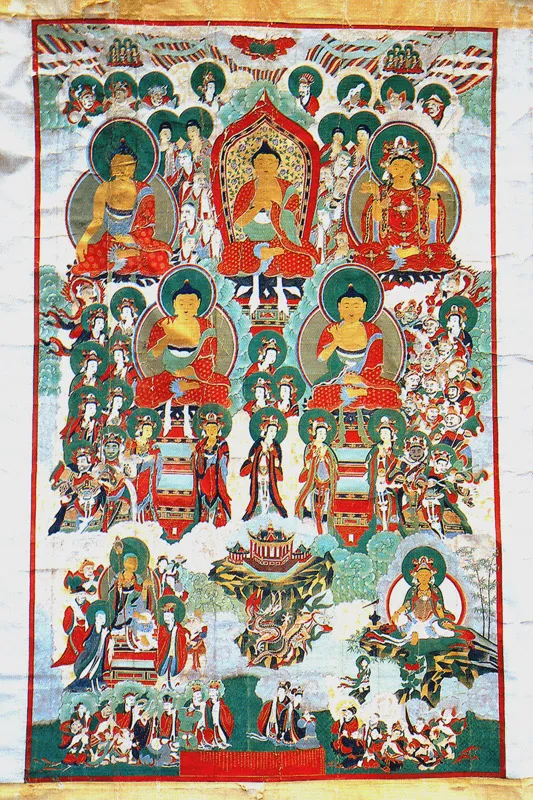
Hanging Painting of Chiljangsa Temple (Five Buddhas)
七長寺 五佛會 掛佛幀
경기도 안성시
Basic information
- Designation
- National Treasure No.296
- Category
- Painting
- Era
- 조선 인조 6년(1628)
- Designated year
- 1997
- Location
- 안성시, 경기도— 경기 안성시 죽산면 칠장로 399-18, 칠장사 (칠장리)
- Coordinates
- 37.026426, 127.397676
AI Docent
Coming soonAn AI-generated, friendly retelling of this heritage site is available in Korean. An English version is on our roadmap — for now, please see the official description below.
Description
Gwaebul is a large Buddhist painting that is hung at the front garden of the sanctuary during sermons or ceremonies. The Hanging Painting at Cheoljangsa Temple was painted by Beophyeong in 1628, the sixth year of King Injo. It was rolled in papers without being put in a box and preserved in the Daeungjeon Hall. It is 659.5cm long and 398.3cm wide and divided into three sections; upper, middle and low. The section divisions are marked by clouds. The upper section holds the images of the three Buddhas. The image of the Buddha of Enlightenment is in the middle and the image of Sakyamuni and Nosanabul stands at his both sides. In the middle section there are many Bodhisattvas including the image of Yaksabul and Amitabha, and also images of heavenly guardians such as the Four Guardian Kings. The images of Yaksabul and Amitabha, along with the image of Sakyamuni in the upper section represent the three Buddhas of the past, present and future. Dosolcheongung Palace, the ideal world of Buddhism, located at the summit of Sumisan Mountain, is painted in the center of the lower section. There are two Bodhisattvas, Avalokitesvara or the Buddhist Goddess of Mercy and Ksitigarbha Bodhisattva, at the sides. Avalokitesvara is sitting on a fantastically shaped rock. Ksitigarbha Bodhisattva is the supreme god of hell. Under the Dosolcheongung Palace, a worshipping crowd can be seen. The arrangement into the above three sections has a purpose. It is intended to enlighten the minds of the worshippers through the world of the image of the three Buddhas and the three Buddhas of the past, present and future, and to tell them they can reach Dosolcheongung Palace through the salvation of Avalokitesvara and Ksitigarbha Bodhisattva. The hanging painting is mostly in green. The contrast between orange yellow and ocher gives the whole picture a rather heavy mood, but the red clothes balance it off. The sophisticated figures and well-wrought structure, delicate touches of the brush make this painting a representative work of the period. It is regarded significant in the study of early 17th century Buddhist paintings.
Location
지도를 불러오는 중…
Have you visited this place?
Log in and verify your visit on-site via GPS to record a stamp in My Journey. (QR verification coming later.)
Images: KOGL (khs.go.kr) · Data source: Korea Heritage Service Open API (khs.go.kr)