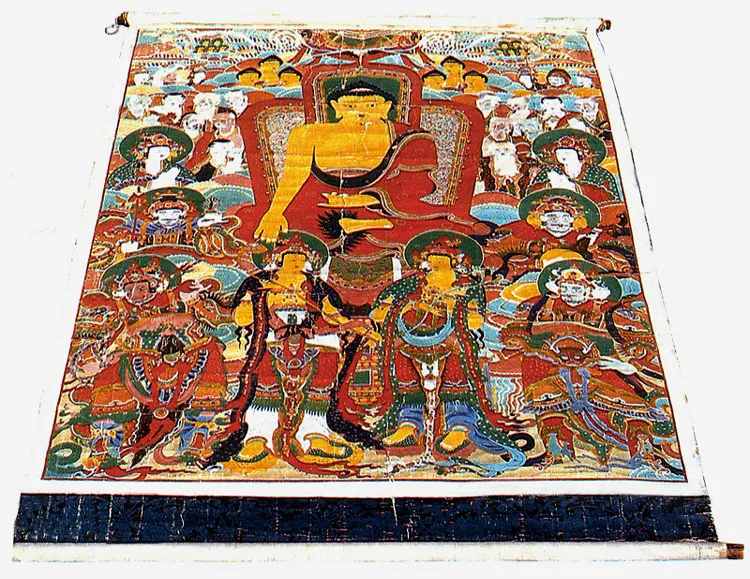
Hanging Painting of Ansimsa Temple (The Vulture Peak Assembly)
安心寺 靈山會 掛佛幀
충청북도 청주시
Basic information
- Designation
- National Treasure No.297
- Category
- Painting
- Era
- 조선 효종 3년(1652)
- Designated year
- 1997
- Location
- 청주시, 충청북도— 충청북도 청주시 서원구 사동길 169-28 (남이면, 안심사)
- Coordinates
- 36.552380, 127.413247
AI Docent
Coming soonAn AI-generated, friendly retelling of this heritage site is available in Korean. An English version is on our roadmap — for now, please see the official description below.
Description
Gwaebul is a large Buddhist painting that is hung at the front garden of the sanctuary during sermons or ceremonies. Yeongsang hoesangdo , which use the scene of Sakyamuni's disciplining as the subject, were frequently painted. This Hanging Painting at Ansimsa Temple was painted in 1652. It is 866cm in length and 485.6cm in width. With the image of Sakyamuni at the center, many Bodhisattvas, including Manjusri Bodhisattva and Bodhisattva of Karuna and the heavenly guardians of Sakyamuni, such as the Four Guardian Kings, are depicted. Sakyamuni has draped on his right shoulder a long gown. He is pointing down the ground with his fingers, which means that the demons are put off. He sits in the center with his fingers arranged this way. His arms and hands are rather long and in this aspect his figure is not so refined. However, his rather angled face and strong features gives his face an austere look and the overall proportion of the body is well proportioned. The flower print highlights the image of Sakyamuni. The things depicted around Sakyamuni get smaller as it gets higher and engenders a feeling of ascension. Red and green are the two main colors used. The colors are painted on rather thickly and there are parts that show signs of too much paint. This increases the opacity. The rather rectangular shape of Sakyamuni's nimbus and face engenders a look of austerity. Compared to other hanging paintings, the number of bodhisattvas is reduced and the figures of the Four Guardian Kings are much larger. This hanging painting was made three years after those at Bosalsa Temple in Cheongju were finished. Still there are many similarities, and along with the hanging painting at Bosalsa, this Gwaebul gives much information on the study of Buddhist paintings of Chungcheong area in the mid 17th century.
Location
지도를 불러오는 중…
Have you visited this place?
Log in and verify your visit on-site via GPS to record a stamp in My Journey. (QR verification coming later.)
Images: KOGL (khs.go.kr) · Data source: Korea Heritage Service Open API (khs.go.kr)