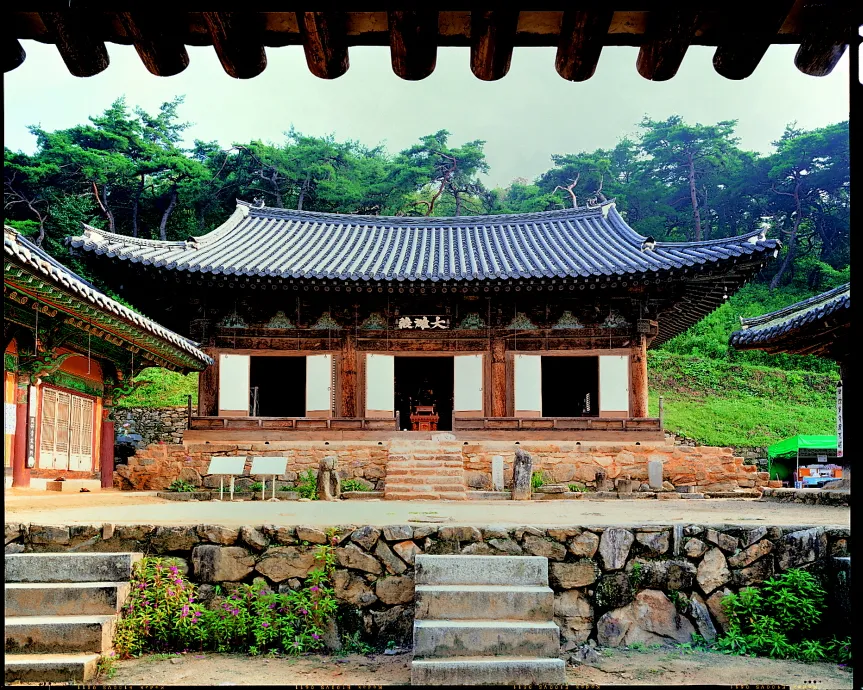
Daeungjeon Hall of Bongjeongsa Temple, Andong
安東 鳳停寺 大雄殿
경상북도 안동시
Basic information
- Designation
- National Treasure No.311
- Category
- Architecture
- Era
- 조선시대 초기
- Designated year
- 2009
- Location
- 안동시, 경상북도— 경북 안동시 서후면 봉정사길 222 (태장리)
- Coordinates
- 36.653442, 128.662676
AI Docent
✨ AI-generated# Daeungjeon Hall of Bongjeongsa Temple Welcome to Daeungjeon Hall, the heart of Bongjeongsa Temple here in Andong. This is where everything sacred happens—imagine stepping into a space where a Buddha statue sits serenely at center, with the images of two bodhisattvas, Manjusri and Samantabhadra, standing beside him. The hall itself dates to the early Joseon Dynasty, over 600 years ago. Notice its elegant simplicity: three sections wide and three deep, topped with a distinctive hipped-and-gabled roof. This understated beauty reflects the architectural style from the end of the previous Goryeo period. Here's what makes this place truly special: the original red and blue paint still glows inside. These colors are treasures for historians studying how our ancestors decorated sacred spaces. Bongjeongsa Temple itself reaches back centuries—possibly to 672, when legend says it was founded. Standing here, you're connecting with over 1,300 years of Korean spiritual life.
⚠ This is an AI-generated retelling of the official description. For accuracy, refer to the official description below.
Description
According to a sangnyangmun (message concerning a ridge beam raising ceremony) of Geungnakjeon Hall, Bongjeongsa Temple appears to have been built by Great Monk Neungin in the late 7th century while legend has it that the temple was built in 672. Daeungjeon Hall is the main shrine where the statue of Buddha is seated at the center, flanked by the images of Manjusri and Samantabhadra. Records found at the time of refurbishment in 1962 show that it dates back to the early Joseon Dynasty (1392-1910). The building measures three kan (unit of measurement referring to the distance between two columns) on the facade by three kan on the side and has a hipped-and-gabled roof. The plain shape of the building displays the characteristics of the buildings built at the end of the Goryeo Period or early Joseon Dynasty. The red and blue colors painted inside the building have been preserved well, serving as important material for those studying the history of building patterns.
Location
지도를 불러오는 중…
Have you visited this place?
Log in and verify your visit on-site via GPS to record a stamp in My Journey. (QR verification coming later.)
Images: KOGL (khs.go.kr) · Data source: Korea Heritage Service Open API (khs.go.kr)