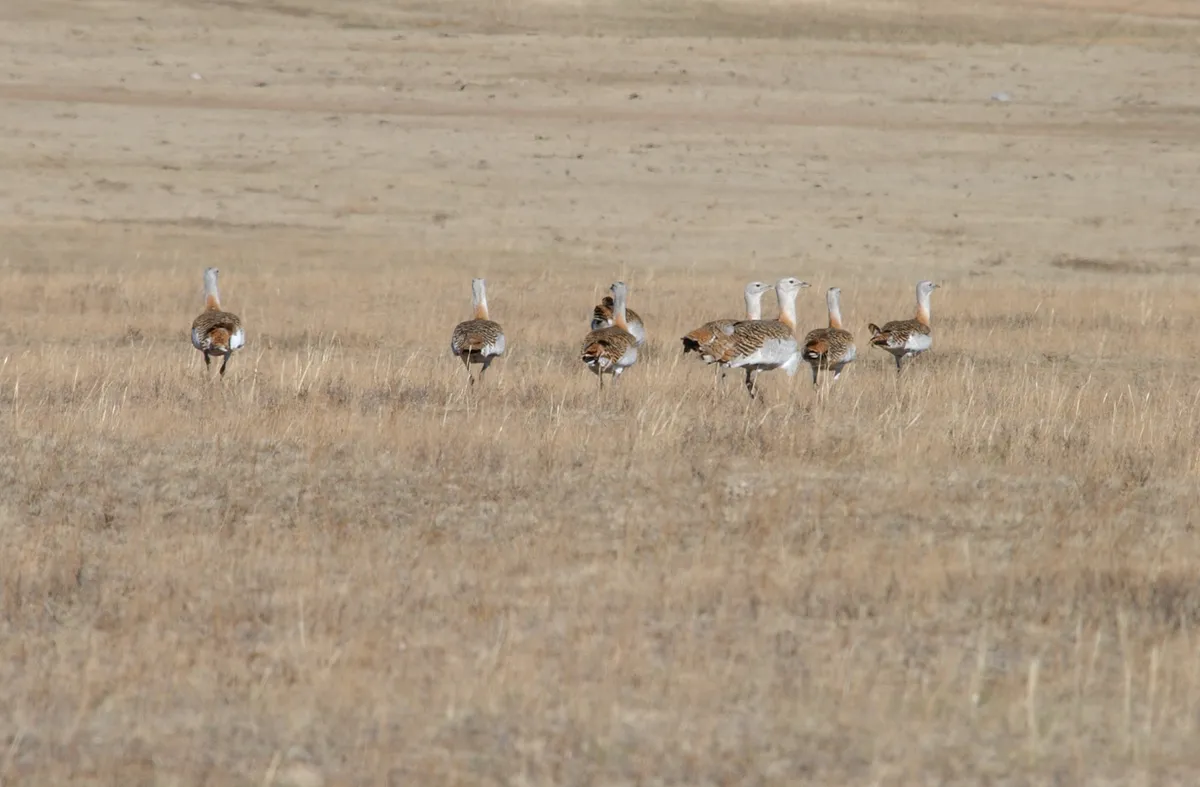
Neusi(deulchilmyeonjo)
기타 .
Basic information
- Designation
- Natural Monument No.206
- Category
- 동식물
- Designated year
- 1968
- Location
- ., 기타— 기타 전국일원
- Coordinates
- No precise coordinates are available, so this item is not shown as a map marker. To be added later.
AI Docent
Coming soonAn AI-generated, friendly retelling of this heritage site is available in Korean. An English version is on our roadmap — for now, please see the official description below.
Description
Machine-translatedThis English description was machine-translated and may contain inaccuracies. Refer to the original Korean text for details.
The great bustard, also known as the field pheasant, is distributed discontinuously from Spain to East Asia. The male measures approximately 102 centimeters in body length while the female measures approximately 76 centimeters, with males being considerably larger. Males display dark tan coloring from the nape to the breast area while females are gray. Males have a maroon band across the breast while females lack this feature. The beak is tan-colored, the tail is dark brown-gray with fine black cross-stripes, and the belly is white. It primarily builds nests on vast plains, agricultural areas, and low brush fields, laying approximately two to three eggs. The species exhibits strong vigilance. Before the Korean War, the great bustard was a common winter migratory bird in Korea, but it has become difficult to find today. With only approximately 20,000 individuals remaining worldwide, the great bustard is a rare species worthy of designation and protection as a natural monument.
Have you visited this place?
Log in and verify your visit on-site via GPS to record a stamp in My Journey. (QR verification coming later.)
Images: KOGL (khs.go.kr) · Data source: Korea Heritage Service Open API (khs.go.kr)