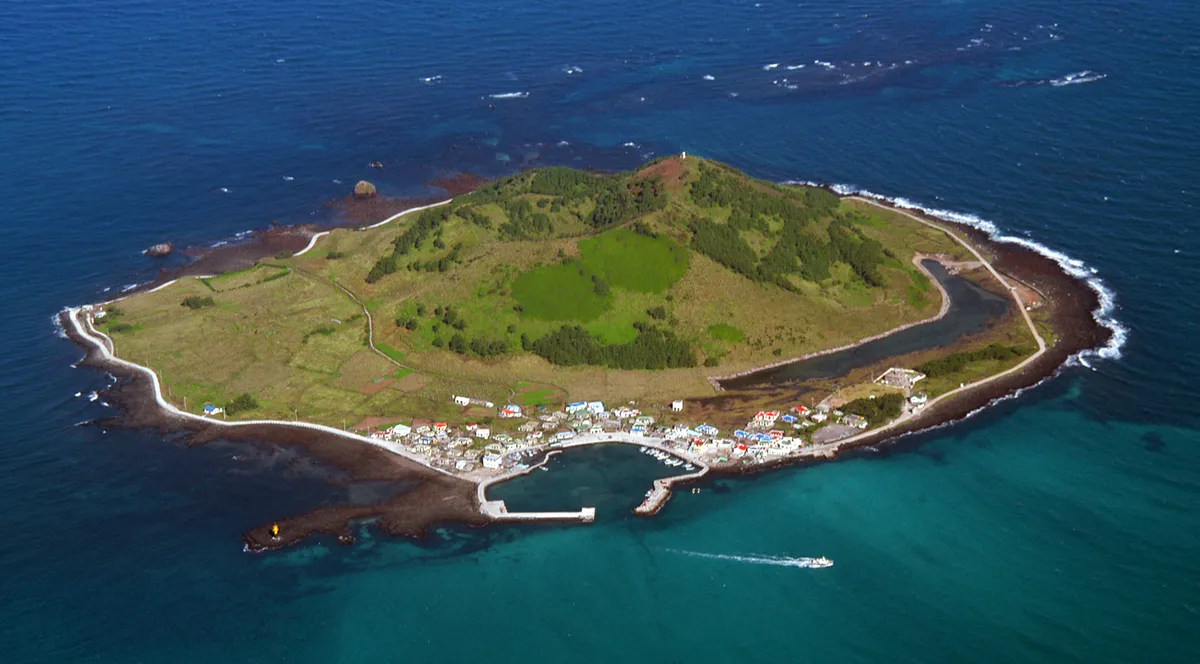
Hornitos on Biyangdo Island, Jeju
濟州 飛楊島 호니토
제주특별자치도 제주시
Basic information
- Designation
- Natural Monument No.439
- Category
- 자연지형
- Designated year
- 2004
- Location
- 제주시, 제주특별자치도— 제주특별자치도 제주시 한림읍 협재리 산 128-2 등 지선에 인접한 공유수면
- Coordinates
- 33.412102, 126.227210
AI Docent
Coming soonAn AI-generated, friendly retelling of this heritage site is available in Korean. An English version is on our roadmap — for now, please see the official description below.
Description
Biyangdo Island is composed of basalt and basalt pyroclastics. The source of the basalt is the crater of Biyangbong Peak, formed through the lateral eruption of a cinder cone. The basalt shows evidence of open-air eruption and consequently less influence on the sea level at the time of eruption. The blisters on the northern coast of Biyangdo Island are commonly called a rock with a baby on its back. A rock formation created through the discharge of gas from the basalt lava, so the blister is hollow. The major blister is 3m high, and there are several other smaller ones. Blisters are volcanic rock structures formed in volcanic areas; they contain vapor or gas generated by the lava or groundwater, but few have the chimney shape like these blisters in Jeju Island. Biyangdo Island is a volcanic island formed through volcanic eruptions in 1002 and 1007. As the only island in Korea whose exact date of volcanic activity is known, and because the blisters on its north coast are of a size and a shape that are hard to find elsewhere, it has great value for academic research.
Location
지도를 불러오는 중…
Have you visited this place?
Log in and verify your visit on-site via GPS to record a stamp in My Journey. (QR verification coming later.)
Images: KOGL (khs.go.kr) · Data source: Korea Heritage Service Open API (khs.go.kr)