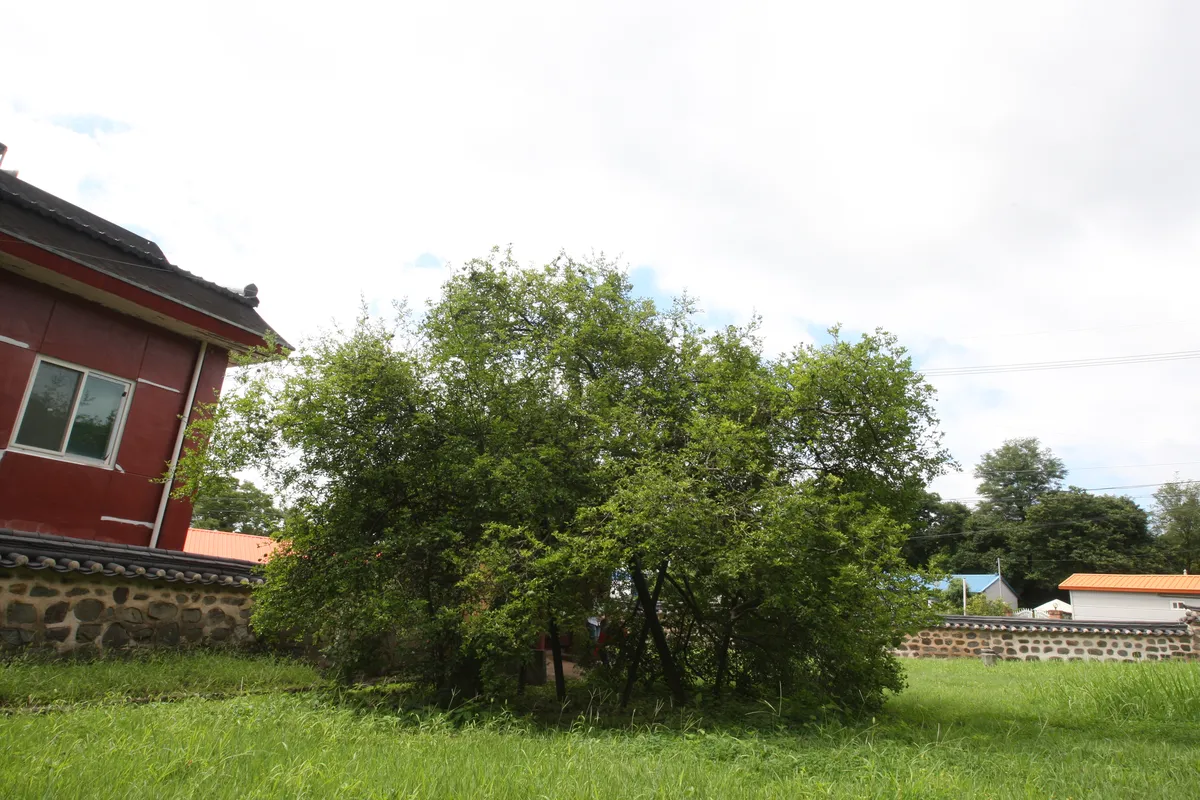
Seokseongdongheon Trifoliate Orange Tree, Buyeo
扶餘 石城東軒 탱자나무
충청남도 부여군
Basic information
- Designation
- Natural Monument No.581
- Category
- 동식물
- Designated year
- 2024
- Location
- 부여군, 충청남도— 충청남도 부여군 석성면 석성리 764-3
- Coordinates
- 36.224478, 126.989082Kakao address conversion
AI Docent
Coming soonAn AI-generated, friendly retelling of this heritage site is available in Korean. An English version is on our roadmap — for now, please see the official description below.
Description
Machine-translatedThis English description was machine-translated and may contain inaccuracies. Refer to the original Korean text for details.
The trifoliate orange tree (Citrus trifoliata) of Seokseongdongheon in Buyeo is located to the right of the inner gate (nasammun) of Seokseong Dongheon—the administrative office building of Joseon-era Seokseong-hyeon, now designated as a Chungcheongnam-do Tangible Cultural Heritage—and is the only surviving ancient trifoliate orange tree at a Joseon-era local government building. It stands 4.8 meters tall with a canopy width of 6.8 meters; the balanced branch development, fruit-bearing condition, and leaf size all indicate excellent form and healthy growing condition. The trifoliate orange is mentioned in numerous Joseon-era texts, including the Sallim Gyeongje (山林經濟) by Hong Man-seon, the Ganji-jip (簡易集) by Choe Rip, and the Dongui Bogam (東醫寶鑑) by Heo Jun, where it is described as serving both military and medicinal purposes—a tree traditionally of great practical use in Korean life. According to the Sallim Gyeongje, the trifoliate orange was used as the thorny hedge plant in wirianchi (圍籬安置)—the Joseon punishment of confining an exile within a thorn fence—and the fact that this specimen at Seokseongdongheon stands in the northeastern part of the compound, in the direction of the former punishment hall (hyeongcheong), is thought to carry symbolic significance. The Buyeo Seokseongdongheon Trifoliate Orange Tree (Citrus trifoliata) holds great historical and academic value, as attested by the abundant documentary records in the Sallim Gyeongje, Dongui Bogam, and other works, as well as its use as the thorny hedge for wirianchi punishment, and is therefore designated and protected as a Natural Monument.
Location
지도를 불러오는 중…
Have you visited this place?
Log in and verify your visit on-site via GPS to record a stamp in My Journey. (QR verification coming later.)
Images: KOGL (khs.go.kr) · Data source: Korea Heritage Service Open API (khs.go.kr)