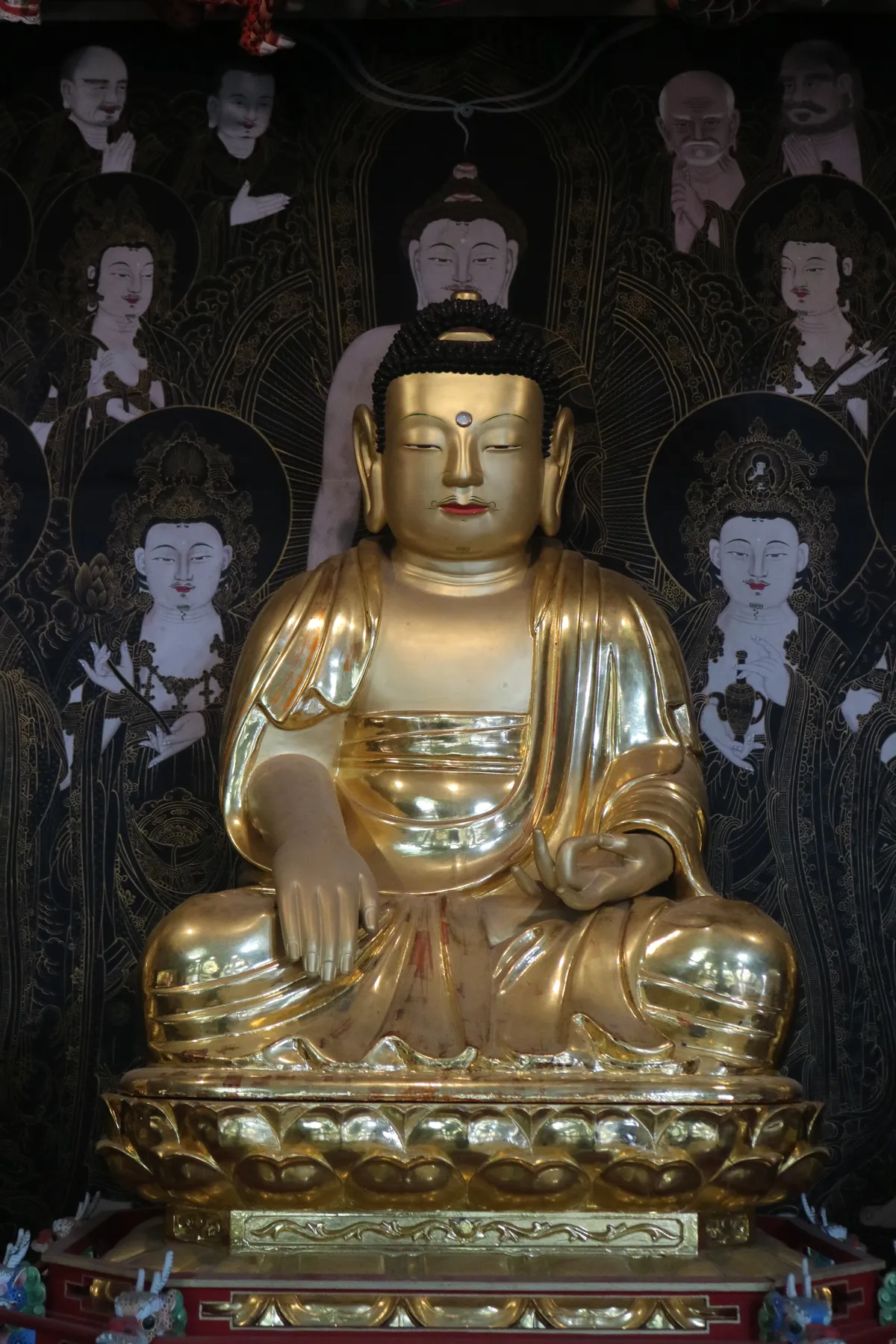
Chilbosa Mokjoseokgayeorae Seated Figure, Seoul
서울 七寶寺 木造釋迦如來坐像
서울특별시 종로구
Basic information
- Designation
- Treasure No.2004
- Category
- Sculpture
- Designated year
- 2018
- Location
- 종로구, 서울특별시— 서울특별시 종로구 삼청로9길 51 (삼청동, 칠보사)
- Coordinates
- 37.588398, 126.980572Kakao address conversion
AI Docent
Coming soonAn AI-generated, friendly retelling of this heritage site is available in Korean. An English version is on our roadmap — for now, please see the official description below.
Description
The Wooden Seated Shakyamuni of Chilbosa Temple in Seoul is conjectured to have been one of the Buddhist statues made in 1622 under the patronage of Queen Jangyeol, a consort of King Gwanghaegun (r. 1608-1623), and enshrined in two royal guardian temples of Jasusa and Insusa. The queen’s patronage of the Buddhist sculptures represented her wishes for the peaceful rest of her deceased parents and royal ancestors. The Shakyamuni statue was carved by a group of monk-sculptors including Hyeonjin, Suyeon, Eungwon and Ingyun, and consequently displays the characteristic techniques of the four artists, who collaborated with each other on this work. Shakyamuni’s head and upper body are slightly bent forward, and he displays the symbolic hand gesture (mudra) of expelling evil by touching the ground. The comparatively short waist, broad shoulders and slightly raised knees are typical features of Hyeonji’s style, while the square, benign face with voluminous cheeks, small, half-closed eyes, sharply raised nose and small, smiling lips were clearly carved by Suyeon. A record on the background and sculptural style of the Shakyamuni statue of Chilbosa Temple show that it is closely related with the Wooden Seated Vairocana Buddha of Jijangam Hermitage in Seoul (Treasure No. 1621). Both statues exhibit fine proportions and a heavy, imposing figure full of energy, carved using comparatively simple techniques, and are regarded as great examples of Korean Buddhist sculpture in the first half of the seventeenth century.
Location
지도를 불러오는 중…
Have you visited this place?
Log in and verify your visit on-site via GPS to record a stamp in My Journey. (QR verification coming later.)
Images: KOGL (khs.go.kr) · Data source: Korea Heritage Service Open API (khs.go.kr)