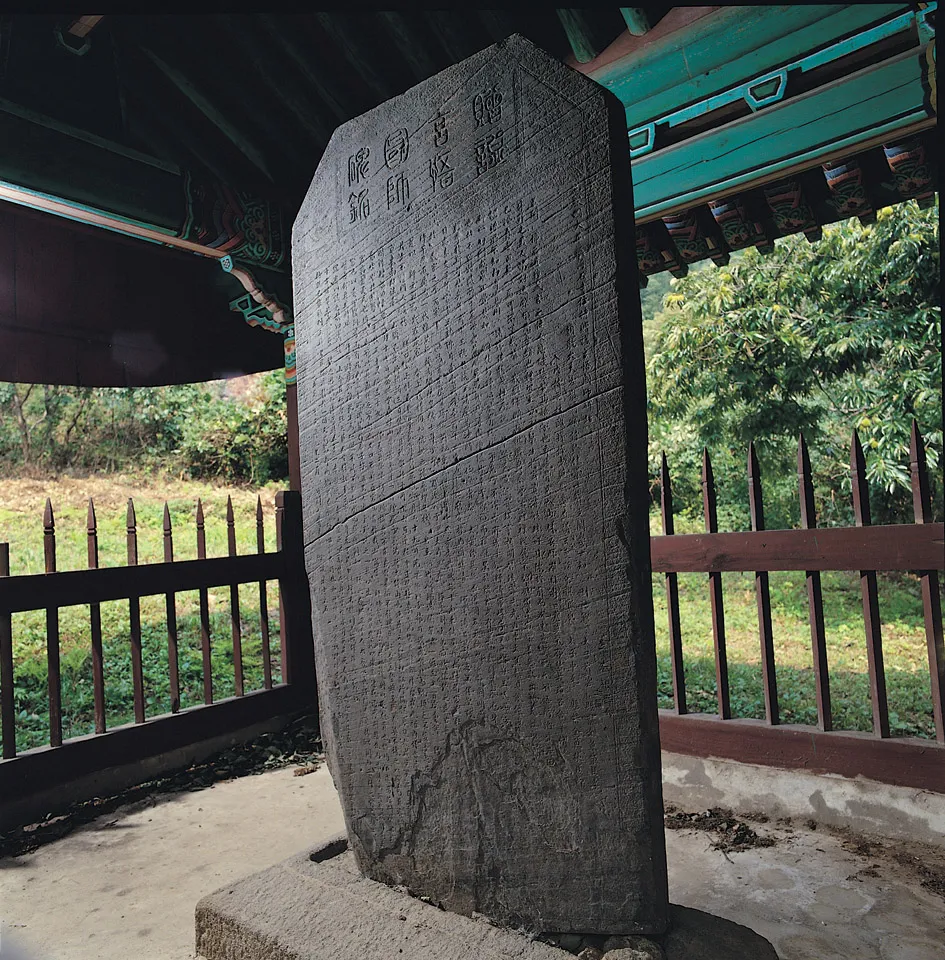
Stele of State Preceptor Hyeono at Seobongsa Temple Site, Yongin
龍仁 瑞鳳寺址 玄悟國師塔碑
경기도 용인시
Basic information
- Designation
- Treasure No.9
- Category
- Books & Records
- Era
- 고려시대
- Designated year
- 1963
- Location
- 용인시, 경기도— 경기 용인시 수지구 신봉동 산110번지
- Coordinates
- 37.337786, 127.038758
AI Docent
Coming soonAn AI-generated, friendly retelling of this heritage site is available in Korean. An English version is on our roadmap — for now, please see the official description below.
Description
There is no record about the construction of Seobongsa Temple, although it is presumed to have been a large temple judging by the size of the site. It was said that during the Japanese Invasion of 1592, the enemy burned down the temple upon seeing water from recently cleansed rice flowing from the temple. It was identified as the site of Seobongsa Temple with the discovery of a roof tile inscribed with a record of Seobongsa Temple during the construction of a house over the stele. This stele was erected in the precincts of Seobongsa Temple in 1185 (the 15th year of the reign of King Myeongjong) to commemorate the achievements of State Preceptor Hyeono. Although steles are usually built with a funerary stupa, there are no traces of a stupa at the temple site, and only the monument remains. The stele is a simple structure consisting of an argillite main stone and a granite foundation stone. The four upper corners of the foundation stone were cut off diagonally, while the two upper edges of the main stone were cut off obliquely. According to the inscription, State Preceptor Hyeono became a monk of Burilsa Temple at the age of 15, and later became the head monk of Buseoksa Temple until his death at the age of 53 in 1178 (the 8th year of the reign of King Myeongjong). He was cremated at the foot of Dongnimsan Mountain. The king, having appointed him as State Preceptor, bestowed upon him the posthumous title of Hyeono. In addition, the author of the inscription and year of construction are recorded on the monument. The stele exhibits the new and simple style introduced during the late Goryeo Dynasty.
Location
지도를 불러오는 중…
Have you visited this place?
Log in and verify your visit on-site via GPS to record a stamp in My Journey. (QR verification coming later.)
Images: KOGL (khs.go.kr) · Data source: Korea Heritage Service Open API (khs.go.kr)