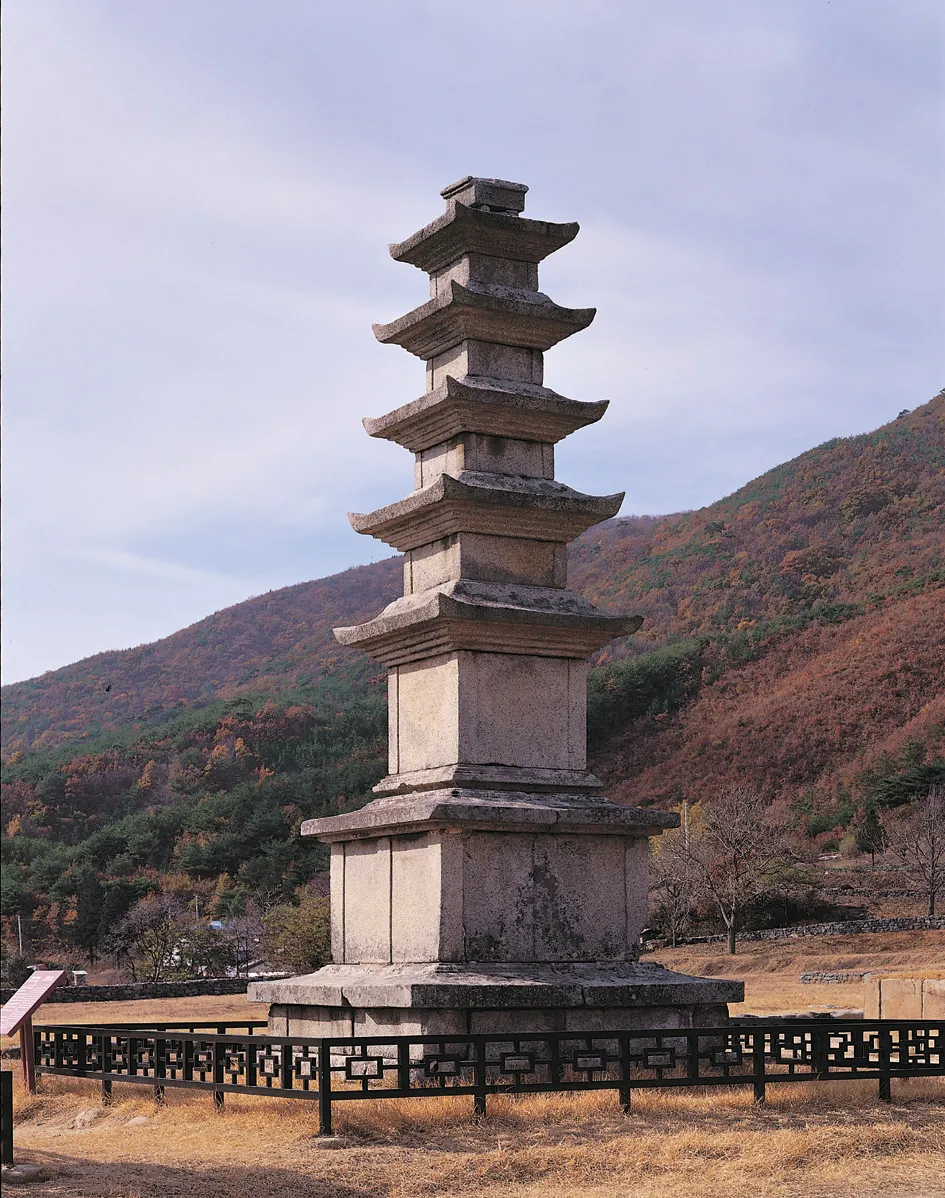
Five-story Stone Pagoda at Seongjusa Temple Site, Boryeong
保寧 聖住寺址 五層石塔
충청남도 보령시
Basic information
- Designation
- Treasure No.19
- Category
- Sites & Pagodas
- Era
- 통일신라시대
- Designated year
- 1963
- Location
- 보령시, 충청남도— 충남 보령시 성주면 성주리 73번지
- Coordinates
- 36.344391, 126.656298
AI Docent
Coming soonAn AI-generated, friendly retelling of this heritage site is available in Korean. An English version is on our roadmap — for now, please see the official description below.
Description
Seongjusa Temple was named by King Munseong of the Unified Silla Period when Nanghye, the temple’s head monk, returned from Tang of China and made the temple prosperous. According to Samguk sagi (History of the Three Kingdoms), Seongjusa Temple was originally named Ohapsa Temple, and was built in the era of King Beop of the Baekje Dynasty. However, it was burnt down during the Japanese Invasion of 1592 and only the site remains. This five-story pagoda is situated in front of what is conjectured to be the site of the main Buddhist hall of Seongjusa Temple. In addition, three other pagodas of a similar style but different heights stand side by side to the rear of the site. This particular pagoda is composed of a two-story platform and a five-story body. The outline of a column is carved on each side and corner of the platform. A flat stone is placed on the platform to support the body stone. In the case of the body stone, both the main and roof stones are made of a single block of stone. Each corner of the stones features carvings of pole-patterns. The supporting stone of the roof is four-stepped. The line of the angle rafter is horizontal while its edge turns slightly up. The overall form of this elegant pagoda is well-structured and follows the typical style of Unified Silla, although the insertion of a flat stone beneath the body stone is more typical of Goryeo. It has been inferred that the pagoda was made in the late Unified Silla Period.
Location
지도를 불러오는 중…
Have you visited this place?
Log in and verify your visit on-site via GPS to record a stamp in My Journey. (QR verification coming later.)
Images: KOGL (khs.go.kr) · Data source: Korea Heritage Service Open API (khs.go.kr)