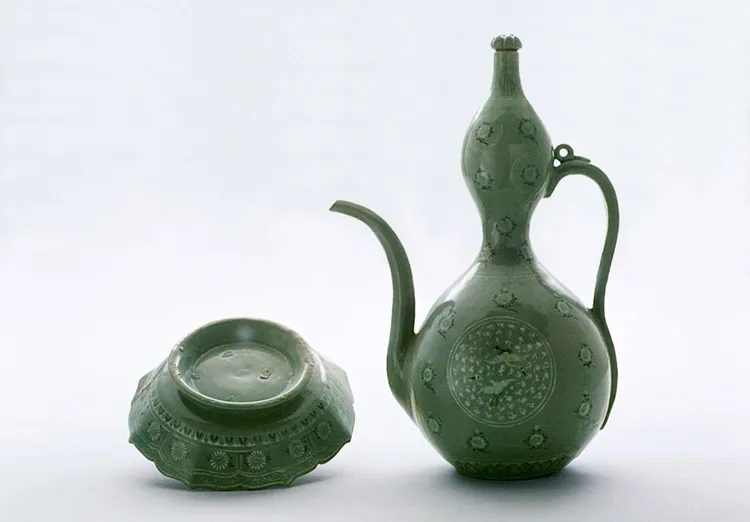
Celadon Sanggamunhakgukhwamun Pyojubakmoyang Jujeonja Mit Seungban
靑磁 象嵌雲鶴菊花文 瓢形 注子 및 承盤
부산광역시 해운대구
Basic information
- Designation
- Treasure No.1033
- Category
- Craft
- Era
- 고려시대
- Designated year
- 1990
- Location
- 해운대구, 부산광역시— 부산광역시 해운대구
- Coordinates
- 35.163067, 129.163596
AI Docent
Coming soonAn AI-generated, friendly retelling of this heritage site is available in Korean. An English version is on our roadmap — for now, please see the official description below.
Description
This set consists of celadon ewer and saucer made in the Goryeo Period. Since the quality of the light blue glaze used on them and the designs found on both pieces are alike, they seem to have been produced as a set from the very beginning. The ewer has height of 33 cm, mouth diameter of 1.9 cm, and base diameter of 8.4 cm. The saucer has height of 5 cm, mouth diameter of 19.3 cm, and base diameter of 11.1 cm. The stopper for the gourd-shaped ewer is shaped like a lotus flower. The ewer used to have a loop that connected the stopper to the handle, but it is now gone. The handle connecting the upper and lower parts seems to have been made by bending a rectangular pole. On top of it is a scroll-shaped loop that connects it to the loop on the stopper. The spout is heavily bent outward and shaped like a diamond. The elaborately cut heel is short and wide. There are several chrysanthemum designs stamped across the surface with enough space among them. In addition, there is a set of crane and clouds engraved inside a large circle made of double lines on both sides in the middle of the lower body. The edges of the saucer are decorated with chrysanthemum and scroll design on the face and lotus flower design on the back. The heel is tall and is spread wide. Its shape and design including the color of glaze display the techniques used in the 13th century when celadon ware was on the decline. Among the many remaining celadon pieces, this is the only ewer accompanied with a saucer.
Location
지도를 불러오는 중…
Have you visited this place?
Log in and verify your visit on-site via GPS to record a stamp in My Journey. (QR verification coming later.)
Images: KOGL (khs.go.kr) · Data source: Korea Heritage Service Open API (khs.go.kr)