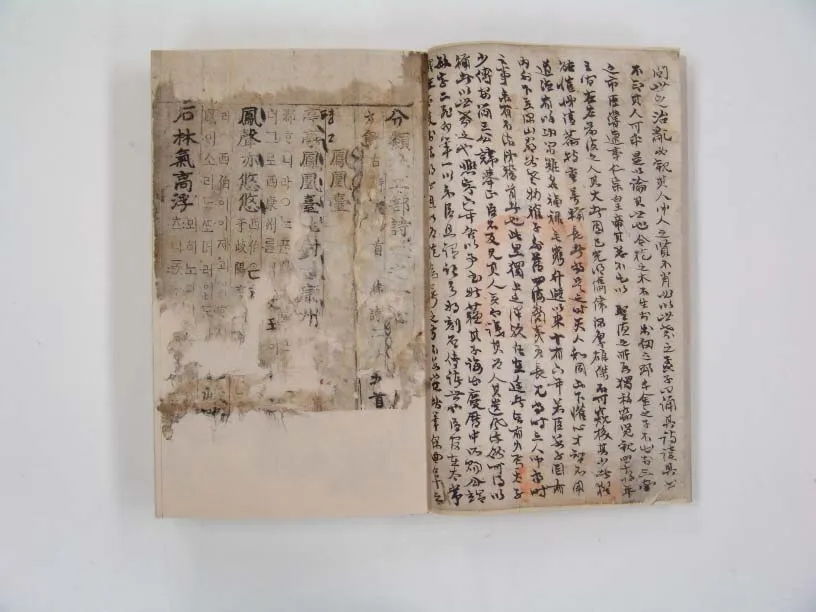
Bunryudugongbusi(eonhae) Gwon17~19
分類杜工部詩(諺解) 卷十七~十九
경상남도 진주시
Basic information
- Designation
- Treasure No.1051-4
- Category
- Books & Records
- Era
- 1489년(성종20)이전
- Designated year
- 2011
- Location
- 진주시, 경상남도— 경상남도 진주시 충의로 19(충무공동, 한국토지주택공사)
- Coordinates
- 35.178170, 128.145768Kakao address conversion
AI Docent
Coming soonAn AI-generated, friendly retelling of this heritage site is available in Korean. An English version is on our roadmap — for now, please see the official description below.
Description
This book of three volumes (Nos. 17, 18 and 19) contains a translation into Korean of the poetry of a famous Tang poet, Du Fu (712-770). The translation was carried out by scholar-officials including Yu Yun-gyeom (1420-?) who were serving in the Office of Expansive Literature (Hongmungwan) according to a royal fiat from King Seongjong (r. 1469-1494) of early Joseon. The book is originally consisted of 25 volumes which were printed with the Eulhae Types cast in 1455. According to the preface Jo Wi (1454-1503) wrote for the first edition to which these volumes belonged, the translation started in fall of 1481 by a royal fiat and completed in the last month the same year. The publication of the book and others, however, had to be postponed because the government had to spend a lot of money to tackle the severe drought that hit the country the following year. A record in The Veritable Records of King Seongjong shows that one set of books were bestowed to the Japanese envoy in the eighth month of 1489, revealing that it was printed before that year. The text shows that the original poems in Chinese were printed in medium-size types and arranged in a single line while the annotations and translations into Korean printed in small types and arranged in double lines. The subjects taken up by the “old poems” and “regulated verses” in these volumes include birds, beasts, insects, fish (Volume 17), flowers, grass, bamboo, tree (Volume 18), gift offering and letter writing (Volume 19). The publication of The Poetry of Du Fu was participated by some of the greatest men of letters in Joseon under the reign of King Seongjong, resulting in the creation of rich poetic expressions and use of diverse Korean vocabularies, making it a very valuable source of knowledge about the Korean language in the 15th century.
Location
지도를 불러오는 중…
Have you visited this place?
Log in and verify your visit on-site via GPS to record a stamp in My Journey. (QR verification coming later.)
Images: KOGL (khs.go.kr) · Data source: Korea Heritage Service Open API (khs.go.kr)