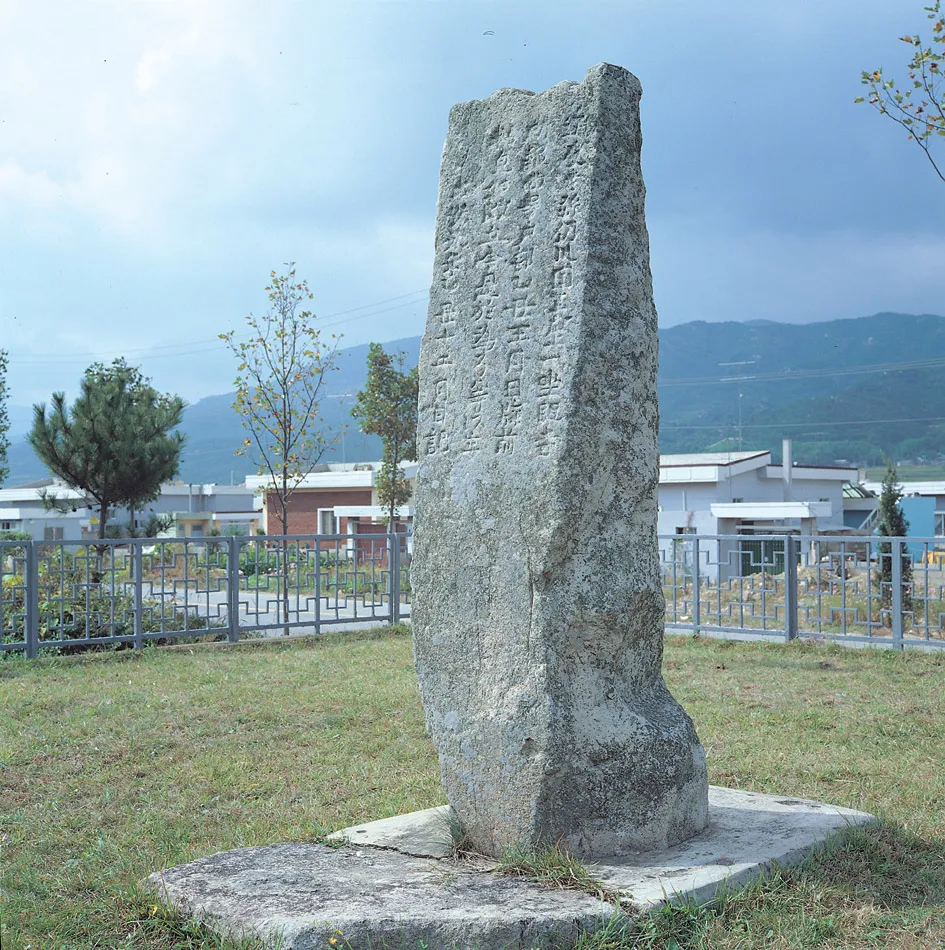
Gukjangsaeng Stone Boundary Marker of Tongdosa Temple, Yangsan
梁山 通度寺 國長生 石標
경상남도 양산시
Basic information
- Designation
- Treasure No.74
- Category
- Sculpture
- Era
- 고려시대
- Designated year
- 1963
- Location
- 양산시, 경상남도— 경남 양산시 하북면 백록리 718-44번지
- Coordinates
- 35.473939, 129.086521
AI Docent
✨ AI-generated# Gukjangsaeng Stone Boundary Marker of Tongdosa Temple Imagine walking about four kilometers from Tongdosa Temple and discovering a weathered stone bearing an ancient inscription—this is the gukjangsaeng, one of twelve boundary markers that once protected the temple's sacred grounds. Erected in 1085 by royal order, this stone marker served a dual purpose: it marked the temple's boundary while acting as a spiritual guardian against harm. The carved inscription and Idu script (a system using Chinese characters to write Korean) reveal something remarkable—they tell us how Korea's government and Buddhist temples worked together during the Goryeo Dynasty. These boundary stones were more than practical markers; they were sacred objects, deeply woven into folk beliefs and geomancy—the ancient art of reading the land's spiritual energy. This particular marker is invaluable because it documents that government-ordered command, offering us a window into temple-state relations centuries ago. Standing before this stone, you're touching a bridge between the spiritual and political worlds of medieval Korea.
⚠ This is an AI-generated retelling of the official description. For accuracy, refer to the official description below.
Description
Situated about 4km southeast of the temple, this boundary marker with an inscription on its rough surface is one of twelve stone boundary markers (gukjangsaeng) erected to demarcate the boundary of Tongdosa Temple. Gukjangsaeng were generally erected by order of the national government. Stone boundary markers serve as guardian gods, markers, and landmarks, and are deeply connected with folk religion and the theory of geomancy. The stone boundary marker at Tongdosa Temple appears to have been erected to protect the temple from harm as well as serving as a boundary post. Erected in 1085 (the second year of the reign of King Seonjong of the Goryeo Dynasty), this marker contains an inscription stating that it was erected at the order of the national government, and an epigraph in Idu, a writing system in which Chinese characters were borrowed to express Korean sounds. This invaluable information sheds light on the relationship between the government and temples.
Location
지도를 불러오는 중…
Have you visited this place?
Log in and verify your visit on-site via GPS to record a stamp in My Journey. (QR verification coming later.)
Images: KOGL (khs.go.kr) · Data source: Korea Heritage Service Open API (khs.go.kr)