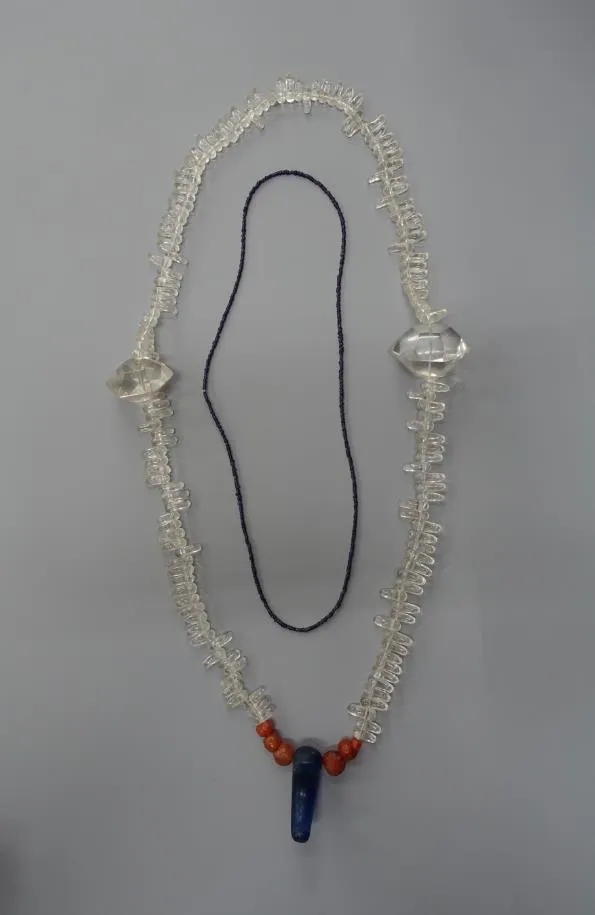
Yangdongri 322hobun Chulto Mokgeori, Gimhae
金海 良洞里 三百二十二號墳 出土 頸飾
부산광역시 부산진구
Basic information
- Designation
- Treasure No.2083
- Category
- Craft
- Era
- 3세기 추정
- Designated year
- 2020
- Location
- 부산진구, 부산광역시— 부산광역시 부산진구 엄광로 176 (가야동, 동의대학교) 동의대학교박물관
- Coordinates
- 35.144318, 129.036310Kakao address conversion
AI Docent
Coming soonAn AI-generated, friendly retelling of this heritage site is available in Korean. An English version is on our roadmap — for now, please see the official description below.
Description
Necklace Excavated from Tomb No. 322 of Yangdong-ri, Gimhae is a artifact excavated from a wooden chamber tomb by the Dong-eui University Museum through an excavation survey conducted three times until 1994. The dates of the tomb from Geumgwan Gaya (the 3rd century) were ascertained based on inclusion of a three-legged bronze caldron in burial ornaments, which turned out to be a ritual object dating to the Han Dynasty in China. This necklace is made of 574 ornaments (i.e. 147 pieces of crystal curved jade, two large-sized crystal multifaceted jade, six agate ring-shaped jade, and 418 pieces of blue glass ring-shaped jade). In fact, it demonstrates the excellent jewelry-making craftsmanship of Gaya culture in processing crystals with a hardness of 7 into multifaceted accessories or producing a large number of curved jade. This necklace is a work of lapidary representative of the Gaya Period, which handled diverse types of gems including crystal, agate, and glass. So, it is regarded as a valuable artifact for the study of ornaments and accessories in the Three-Kingdoms Period. It is also unprecedented that a total of 147 pieces crystal curved jade were excavated from a single ancient tomb. Accordingly, it is known where this necklace was excavated, and it serves as a rare instance of a large number of crystal curved jade and large-sized glass curved jade pieces being excavated from a single tomb. What’s more, they demonstrate the intricate skills of processing accessories made of crystals with diverse colors and texture. The necklace excavated from Tomb No. 322 of Yangdong-ri Tumuli is a valuable artifact that reveals the Gaya people’s refined taste in accessories of that period.
Location
지도를 불러오는 중…
Have you visited this place?
Log in and verify your visit on-site via GPS to record a stamp in My Journey. (QR verification coming later.)
Images: KOGL (khs.go.kr) · Data source: Korea Heritage Service Open API (khs.go.kr)