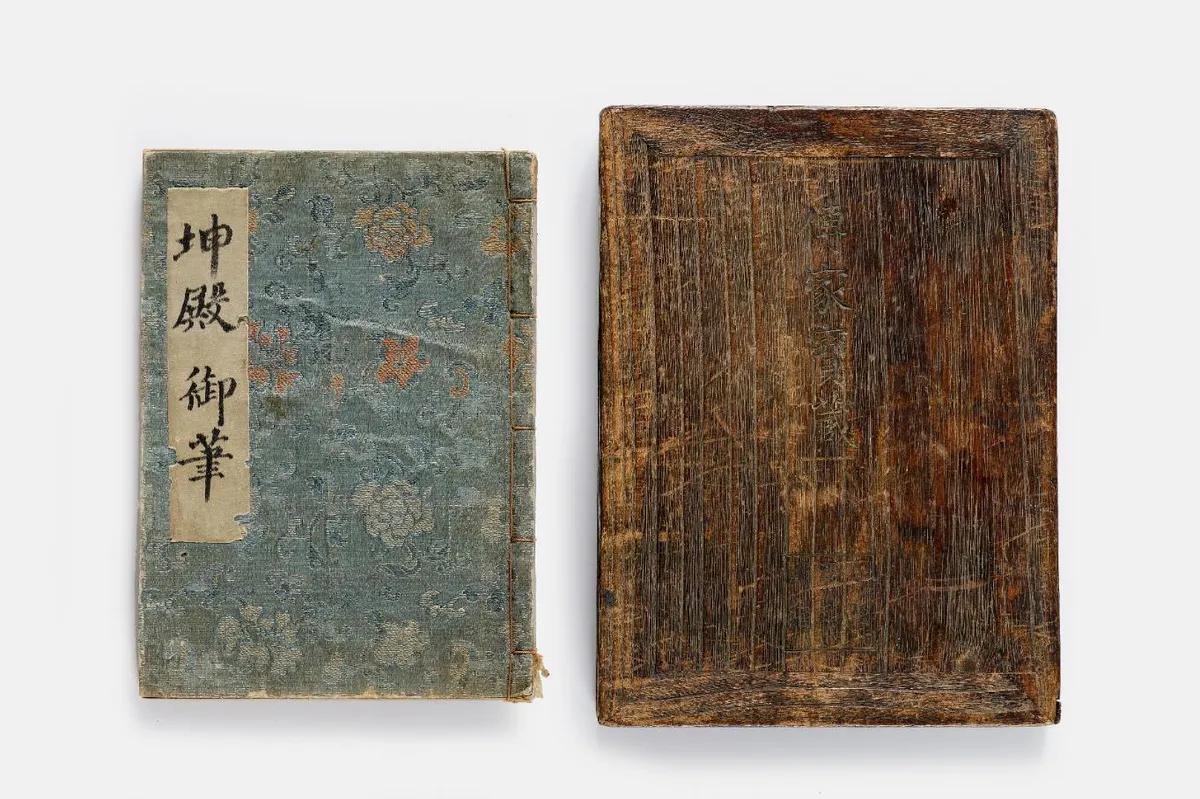
Hyouiwanghu Eopil Mit Ham-manseokgunjeonㆍgwakjaui Hall
孝懿王后 御筆 및 函-萬石君傳ㆍ郭子儀傳
서울특별시 용산구
Basic information
- Designation
- Treasure No.2087
- Category
- Books & Records
- Era
- 1794년(정조 18)
- Designated year
- 2020
- Location
- 용산구, 서울특별시— 서울특별시 용산구 서빙고로 139 (용산동6가, 국립한글박물관)
- Coordinates
- 37.521069, 126.980486Kakao address conversion
AI Docent
Coming soonAn AI-generated, friendly retelling of this heritage site is available in Korean. An English version is on our roadmap — for now, please see the official description below.
Description
The Calligraphy by Queen Hyoui and Case (Manseokgunjeon and Gwakjauijeon) (Treasure No. 2087) is a book transcribed by Queen Hyoeui (1753-1821), the wife of King Jeongjo (r. 1776-1800) of the Joseon dynasty, based on the story about Shifen contained in Hanshu (The Book of the Han Dynasty of China) and the story about Guo Ziyi contained in XinTangShu (The New Tang Chronicles), which were translated into Korean by her nephew Kim Jongseon at her request. Queen Hyoeui’s cousin, Kim Gihu, wrote a postscript about the book’s production which states that the Queen transcribed certain historic records in 1793 and asked her nephew Kim Jongjil to translate the stories about Shifen and Guo Ziyi into Korean, and then transcribed by herself in 1794. In the book’s postscript, Queen Hyoeui states: “Shifen set a great example as a loyal, simple, and generous person, while Guo Ziyi was a paragon of modesty, reserve, and self-effacement. Every member of our family, which has declined, must learn from them.” Thus, it seems that she transcribed the book out of a wish to see the family of her parent’s home prosper and live in peace. The Calligraphy by Queen Hyoui and Case (Manseokgunjeon, Gwakjauijeon was kept in a wooden book chest with a hinged lid. The subject of the book, (坤殿御筆) (A Material Handwritten by the Queen), was written on a separate sheet of paper and then attached to the book’s cover. Her postscript in Hangeul is placed after the main text and followed by Kim Gihu’s postscript in both Hangeul and Chinese characters. The Queen’s handwriting, which is refined and sophisticated, may be said to be a model of the cursive writing style of Hangeul. It is regarded as a precious material that offers insights into the royal family of that time. The Calligraphy by Queen Hyoui and Case (Manseokgunjeon, Gwakjauijeon is particularly valuable in that there are very few books containing material transcribed by a queen along with a postscript written in her hand. It is also significant from the perspective of Korean literature, calligraphy, and history. As it is clear when and why the book was made and who wrote the transcriptions, it is also a useful reference work for studies on the history of royal Hangeul calligraphy during the Joseon period. The paulownia wood book chest inscribed with the expressions “傳家寶藏” (“Valued by the family”) and “子孫其永寶藏” (“To be forever cherished by our descendants”) is worthy of designation as a Treasure as it displays certain characteristic features of this type of late Joseon artifact and is known to be a contemporary of Queen Hyoui’s book.
Location
지도를 불러오는 중…
Have you visited this place?
Log in and verify your visit on-site via GPS to record a stamp in My Journey. (QR verification coming later.)
Images: KOGL (khs.go.kr) · Data source: Korea Heritage Service Open API (khs.go.kr)