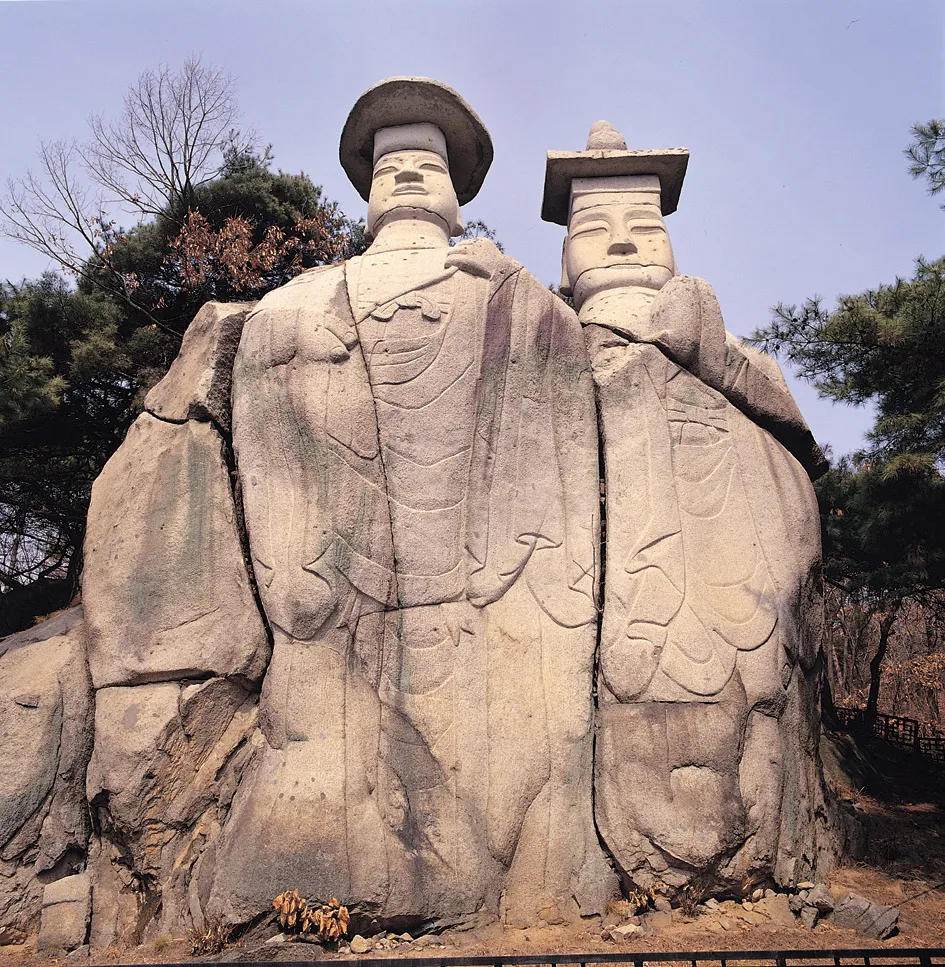
Two Rock-carved Standing Buddhas in Yongmi-ri, Paju
坡州 龍尾里 磨崖二佛立像
경기도 파주시
Basic information
- Designation
- Treasure No.93
- Category
- Sculpture
- Era
- 고려시대
- Designated year
- 1963
- Location
- 파주시, 경기도— 경기 파주시 광탄면 용미리 산8, 9번지
- Coordinates
- 37.754187, 126.864541
AI Docent
Coming soonAn AI-generated, friendly retelling of this heritage site is available in Korean. An English version is on our roadmap — for now, please see the official description below.
Description
These two magnificent Buddha images were carved on a large natural rock wall. As they are carved in natural stone, the bodies of the two Buddhas are rather disproportionate, giving the statues an outsized appearance. Thus, these Buddhas exhibit a regional style characterized by secular rather than Buddhist characteristics. The "rounded" Buddha statue on the left is wearing a round-shaped traditional Korean hat. Its neck is a cylindrical in shape and its hands are holding a lotus flower to its chest. The "square" Buddha statue on the right is wearing a square-shaped traditional Korean hat, and is sculpted in much the same way as the other statue, except its two hands are pressed together as if in prayer. According to oral tradition, the Buddha with the round hat is a male Buddha while the other is a female Buddha. During the Goryeo Dynasty, the childless King Seonjong (1049~1094, r. 1083~1094) married Princess Wonsin, but they were unable to have a child. One day, the worried princess dreamt that she met two Buddhist priests who had attained spiritual enlightenment. They said, "We live between some rocks on the southern slope of Mt. Jangjisan. We are very hungry. Give us something to eat." Then they disappeared. The princess considered this dream so strange that she told the king about it. He immediately sent some people to Mt. Jangjisan, where they found two big rocks standing side by side. The king ordered the two Buddhist priests to be carved on this rock, built a temple there, and presented an offering to Buddha. That year Prince Hansanhu was born. Although these Buddha images are not very refined works of Goryeo, they are considered precious materials for studies on the regional style of the Buddha images of the Goryeo Period, as is the enduring birth legend of these rock-carved standing Buddhas.
Location
지도를 불러오는 중…
Have you visited this place?
Log in and verify your visit on-site via GPS to record a stamp in My Journey. (QR verification coming later.)
Images: KOGL (khs.go.kr) · Data source: Korea Heritage Service Open API (khs.go.kr)