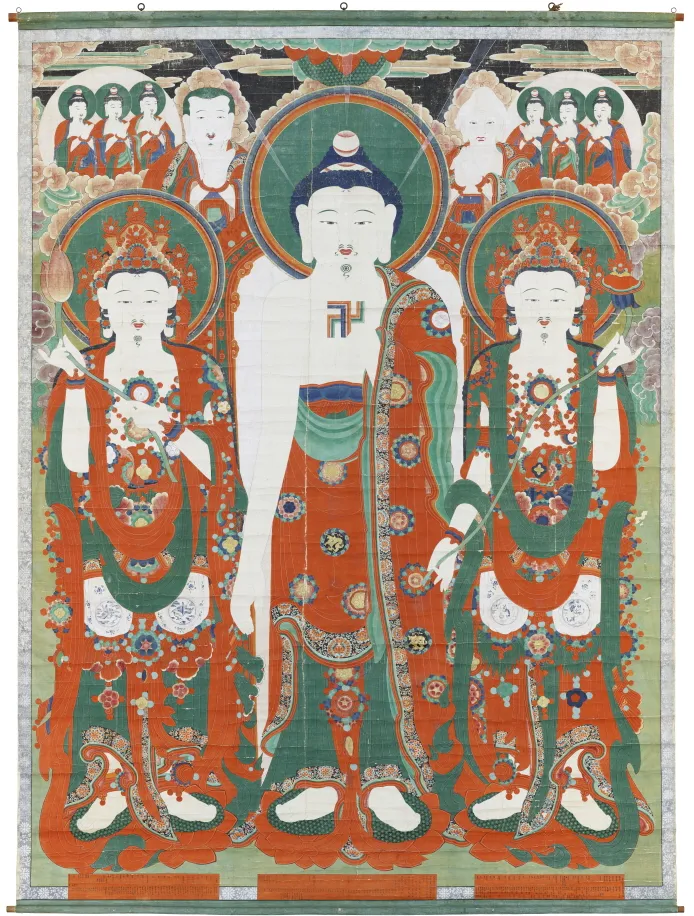
Okcheonsa Yeongsanhoe Gwaebuldo Mit Ham, Goseong
固城 玉泉寺 靈山會 掛佛圖 및 函
경상남도 고성군
Basic information
- Designation
- Treasure No.2110
- Category
- Painting
- Era
- 1808년(순조 8)
- Designated year
- 2021
- Location
- 고성군, 경상남도— 경상남도 고성군 연화산1로 471-9 (개천면, 옥천사)
- Coordinates
- 35.080849, 128.262079Kakao address conversion
AI Docent
Coming soonAn AI-generated, friendly retelling of this heritage site is available in Korean. An English version is on our roadmap — for now, please see the official description below.
Description
The hanging scroll drawing of Shakyamuni Preaching the Lotus Sutra at Vulture Peak, Gijjhakuta Hill along with the case kept at Okcheonsa Temple (National Treasure No. 2110) are a massive artifact measuring more than 10 m in height composed of 20 pieces. It was made by 18 painting monks including Pyeongsam in 1808 (the 8th year of King Sunjo’s reign). It depicts images of Shakyamuni Triad, Saints Anan, Gaseop, and six other Buddhas. The slender bodies and facial features thinly portrayed in round faces, child-like faces, the use of vivid decorative patterns and the technique designed to accentuate the impressive effect with making ostentatious patterns by using gold foil, blending the primary red and greens with blue and white make it look associated with those at Yongmunsa Temple in Namhae (1769) and Manyeonsa Temple in Hwasun (1783). Compared to the other two’s depiction of the triad in similar sizes, this drawing makes the attendant bodhisattvas smaller, displaying the painting style of Monk Pyeongsam, who made an attempt at a change in painting composition. Overall, this hanging scroll drawing has inherited the traditional painting style of the 18th century, while reflecting the new style of the 19th century in terms of colors, proportion, facial feature expressions, and line drawing technique, and displaying a transitional style. The case for keeping the drawing is one made in the same era as the painting . The drawing’s finishing touches use lacquer and diverse shapes of traditional hardware of fine aesthetic quality. The hanging scroll drawing of Shakyamuni Preaching the Lotus Sutra at Vulture Peak, which has records on when it was made and handwritten writings in Indian ink , is a valuable artifact for the study of the history of the Korea’s classical handcraft.
Location
지도를 불러오는 중…
Have you visited this place?
Log in and verify your visit on-site via GPS to record a stamp in My Journey. (QR verification coming later.)
Images: KOGL (khs.go.kr) · Data source: Korea Heritage Service Open API (khs.go.kr)