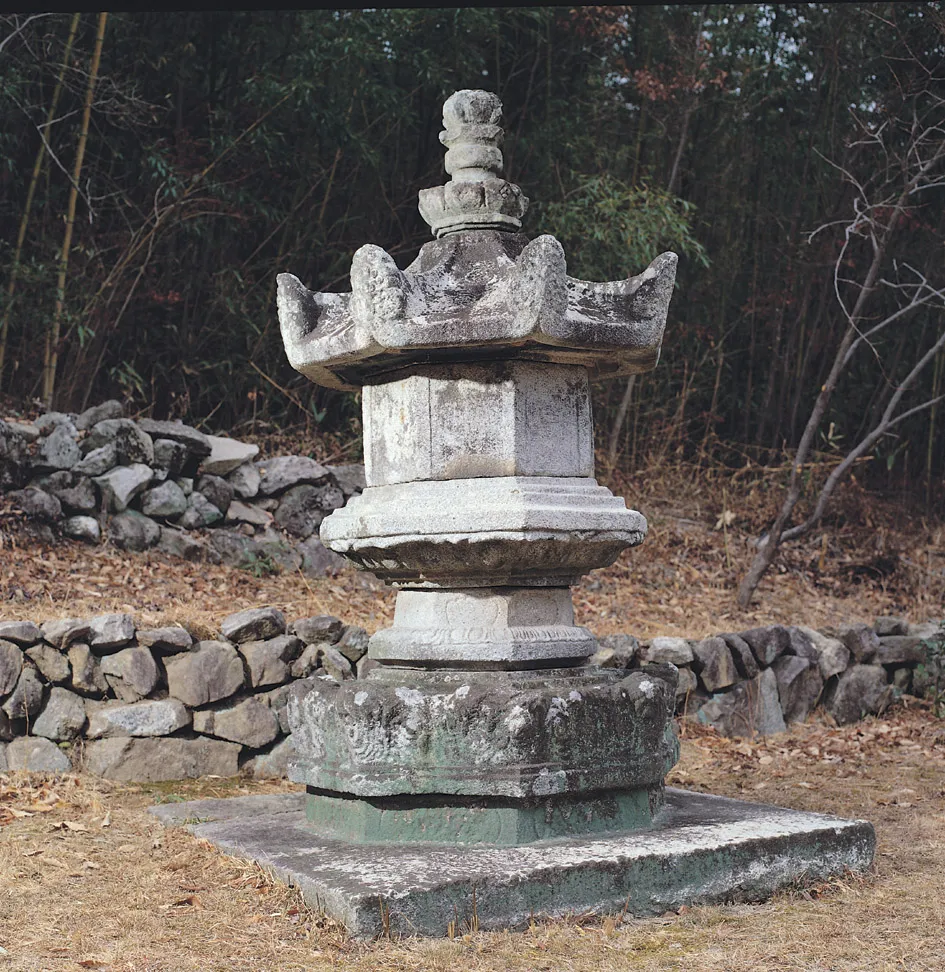
Buddhist Stupa at Daegakam Hermitage of Seonamsa Temple, Suncheon
順天 仙巖寺 大覺庵 僧塔
전라남도 순천시
Basic information
- Designation
- Treasure No.1117
- Category
- Sites & Pagodas
- Era
- 고려시대
- Designated year
- 1992
- Location
- 순천시, 전라남도— 전남 순천시 승주읍 죽학리 산48-1번지
- Coordinates
- 34.996252, 127.326916
AI Docent
✨ AI-generatedWelcome to the Buddhist Stupa at Daegakam Hermitage! You're standing at a masterpiece of Korean stone carving, built during the early Goryeo Period at a site with deep roots—Seonamsa Temple was founded way back in 875 by the Buddhist monk Doseon. This stupa is a remarkable octagonal structure, and if you look closely, you'll see why it's special. The three-story platform beneath it features beautiful carved details: clouds dance across the bottom level, round designs wrap the middle, and eight lotus petals frame the top. The stupa's body itself is carved with pillar designs at each corner, plus a door and padlock on the front and back—intricate stonework that reflects master craftsmanship. The roofstone is substantial and heavy, with decorative flowers adorning each eave's edge. Topping it all off are finial ornaments shaped like a wheel and lotus bud. This stupa embodies the spiritual achievement of State Preceptor Daegak, who reached enlightenment in this very hermitage. It's a testament to Korean Buddhism's golden age.
⚠ This is an AI-generated retelling of the official description. For accuracy, refer to the official description below.
Description
Seonamsa Temple was built by Buddhist Monk Doseon in 875 (fifth year of the reign of King Heongang during the Unified Silla Period) and was expanded by State Preceptor Daegak in 1088 (sixth year of the reign of King Seonjong of the Goryeo Dynasty). Daegakgam literally means “Hermitage of Great Enlightenment”; this hermitage was named as such since State Preceptor Daegak achieved enlightenment here. This stupa is one of the typical octagonal stupas whose body is placed on the three-story octagonal platform. The bottom platform is carved with cloud designs on the sides, and the middle platform, with round designs on each side. The top platform is surrounded by carvings of eight lotus petals. The body of the stupa is carved with pillar designs on every corner, along with a door and a padlock carved on the front and the back. The roofstone is flat and heavy with thick edges on the eaves; decorating the end of each eave is a flower design. The finial ornaments are made in the shapes of wheel and lotus bud to be placed on top of the stupa. This stupa is presumed to have been built in the early Goryeo Period, judging from the carving technique and the shape of roofstone.
Location
지도를 불러오는 중…
Have you visited this place?
Log in and verify your visit on-site via GPS to record a stamp in My Journey. (QR verification coming later.)
Images: KOGL (khs.go.kr) · Data source: Korea Heritage Service Open API (khs.go.kr)