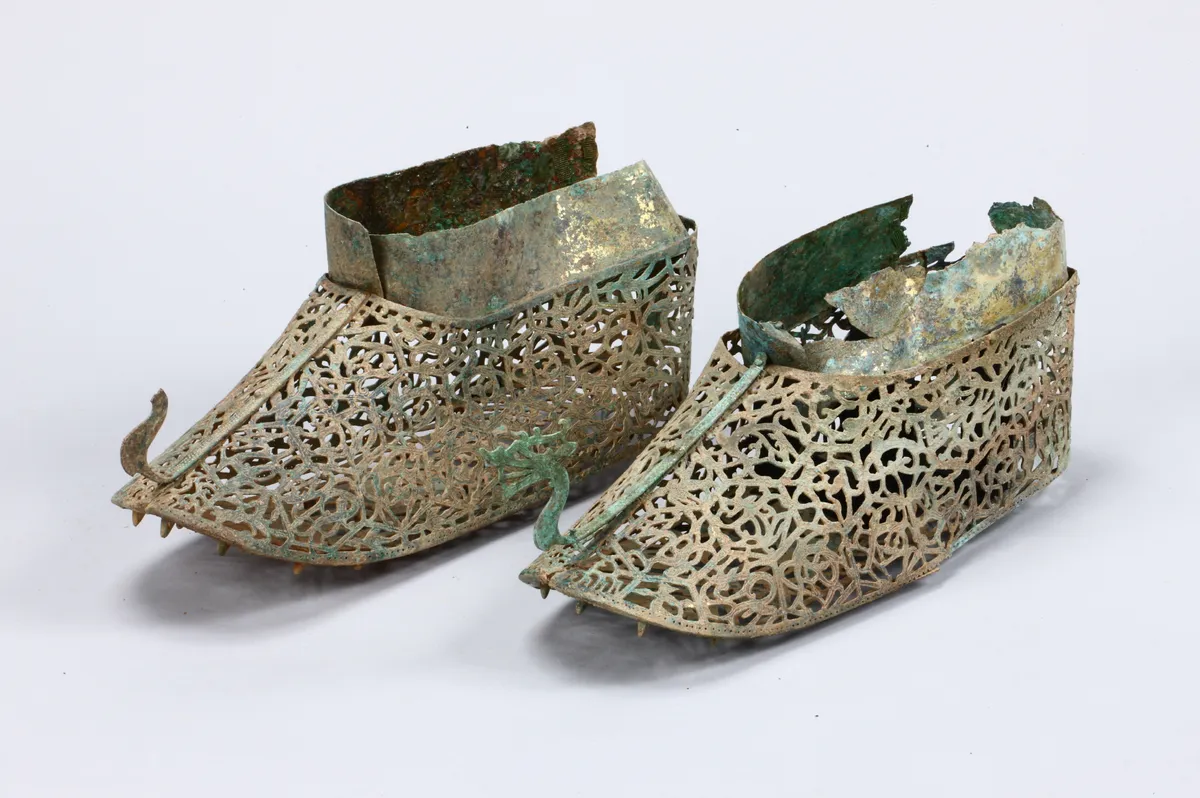
Jeongchongobun Chulto Geumdongsinbal, Naju
(羅州 丁村古墳 出土 金銅飾履)
전라남도 나주시
Basic information
- Designation
- Treasure No.2125
- Category
- Craft
- Era
- 5세기
- Designated year
- 2021
- Location
- 나주시, 전라남도— 전라남도 나주시
- Coordinates
- 35.015898, 126.710829
AI Docent
Coming soonAn AI-generated, friendly retelling of this heritage site is available in Korean. An English version is on our roadmap — for now, please see the official description below.
Description
Machine-translatedThis English description was machine-translated and may contain inaccuracies. Refer to the original Korean text for details.
The Naju Jeongchon Tomb gold-bronze shoes were excavated from the first stone chamber of the Jeongchon Tomb, a large Three-Kingdoms period mound burial in 2014 by the National Naju Cultural Heritage Research Institute. During the fifth-to-sixth century, large mound tombs including Bogamri Tomb Group, Jeongchon Tomb, and Yeongdongri Tomb Group were constructed in the Yeongsangang region, with Jeongchon Tomb proving most comprehensively representative of combined Baekje-Mahan culture while avoiding looting, establishing exceptional archaeological significance through preserved original burial conditions. A pair of gold-bronze shoes discovered in the third coffin of the Jeongchon Tomb's first stone chamber appeared in nearly perfect undamaged condition. Notably, dragon-head ornaments attached to the instep section represent the sole surviving example among extant Three-Kingdoms gold-bronze shoes, drawing scholarly attention. Recent scientific analysis by the National Naju Cultural Heritage Research Institute suggested the shoe owner as an estimated forty-year-old female. These gold-bronze shoes demonstrate remarkable formal and manufacturing technique similarity with Gochang Bongdeokri examples. Thin gold-bronze sheets of four components form the sole plate, left-right side plates, and ankle collar plate, connected via small nails with perforated designs detailed through linear description, reflecting sophisticated ancient metalcraft techniques. Additionally, hexagonal designs, dragon motifs, human-faced bird-bodied creatures, mythical beasts, and lotus flowers expressing post-mortem eternal-life aspiration, combined with refined technical execution, establish exceptional artistic merit. The Naju Jeongchon Tomb gold-bronze shoes, created in late fifth century (slightly later than Gochang Bongdeokri examples) and connecting to sixth-century Muryeong Wang's mausoleum shoe tradition, represent transitional metalcraft exemplifying overarching development phases. These shoes merit recognition as important works revealing fifth-to-sixth century Baekje thought and art understanding.
Location
지도를 불러오는 중…
Have you visited this place?
Log in and verify your visit on-site via GPS to record a stamp in My Journey. (QR verification coming later.)
Images: KOGL (khs.go.kr) · Data source: Korea Heritage Service Open API (khs.go.kr)