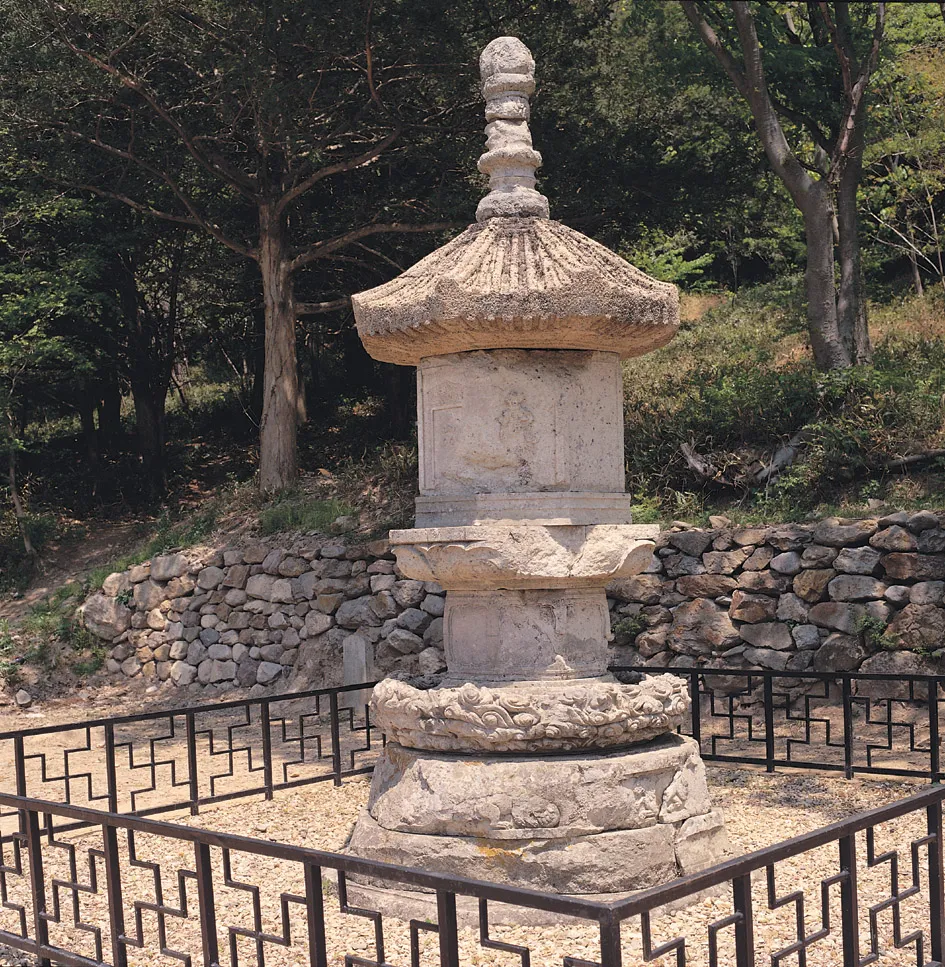
Stupa of Master Bojo at Borimsa Temple, Jangheung
長興 寶林寺 普照禪師塔
전라남도 장흥군
Basic information
- Designation
- Treasure No.157
- Category
- Sites & Pagodas
- Era
- 통일신라시대
- Designated year
- 1963
- Location
- 장흥군, 전라남도— 전남 장흥군 유치면 봉덕리 산10-1번지 보림사
- Coordinates
- 34.808499, 126.897490
AI Docent
Coming soonAn AI-generated, friendly retelling of this heritage site is available in Korean. An English version is on our roadmap — for now, please see the official description below.
Description
This stupa was erected in 880 (the 6th year of the reign of King Heongang of the Silla Dynasty) at Borimsa Temple in Jangheung County to enshrine the sarira of Master Bojo. Bojo (804~880) became a Buddhist monk in his early years and devoted himself to study of the Buddhist scriptures. In 827 (the second year of the reign of King Heungdeok of the Silla Dynasty) he received the religious precepts and devoted himself to their practice. In 837 (the second year of the reign of King Heuigang) he went to China and returned in 840 (the 2nd year of the reign of King Munseong) and preached Zen to many monks. He was appointed as the head monk of Borimsa Temple at the request of King Heonan in 859 (the 3rd year of the reign of King Heonan) and in 880 entered Nirvana at the age of 77. The King granted him the posthumous title of "Master Bojo" and named the stupa "Changseong". The stupa is octagonal in form from the base to the top, adopting the typical style of stupas erected during Unified Silla. As for the three-tiered stylobate, the bottom-tier stone supporting the main body is embossed with a vivid cloud design; the middle-layer stone is decorated with two bands in the lower part, giving it a bulging appearance. The core stone of the main body lies on the supporting stone, which is carved with eight large lotus patterns. The front and back surfaces of the core stone are engraved with an old Korean-style door, while its other two surfaces are engraved with images of the Four Guardian Kings. The roof stone looks thick, and a cornice is expressed on its lower part. The sloping side of the roof contains runnels to drain away rainwater. Although the upper ornamental part is incomplete, the top of the finial consists of a bokbal (over-turned bowl), boryun (mast with nine discs), and boju (magic bead) arranged in that order. The core stone is too large compared with the roof stone, and looks unnatural overall in that the material of the roof stone differs from the other stones. The sarira was stolen from the stupa during the Japanese occupation of Korea, while the stupa itself collapsed. The stupa has been restored to some extent, but is still damaged in parts.
Location
지도를 불러오는 중…
Have you visited this place?
Log in and verify your visit on-site via GPS to record a stamp in My Journey. (QR verification coming later.)
Images: KOGL (khs.go.kr) · Data source: Korea Heritage Service Open API (khs.go.kr)