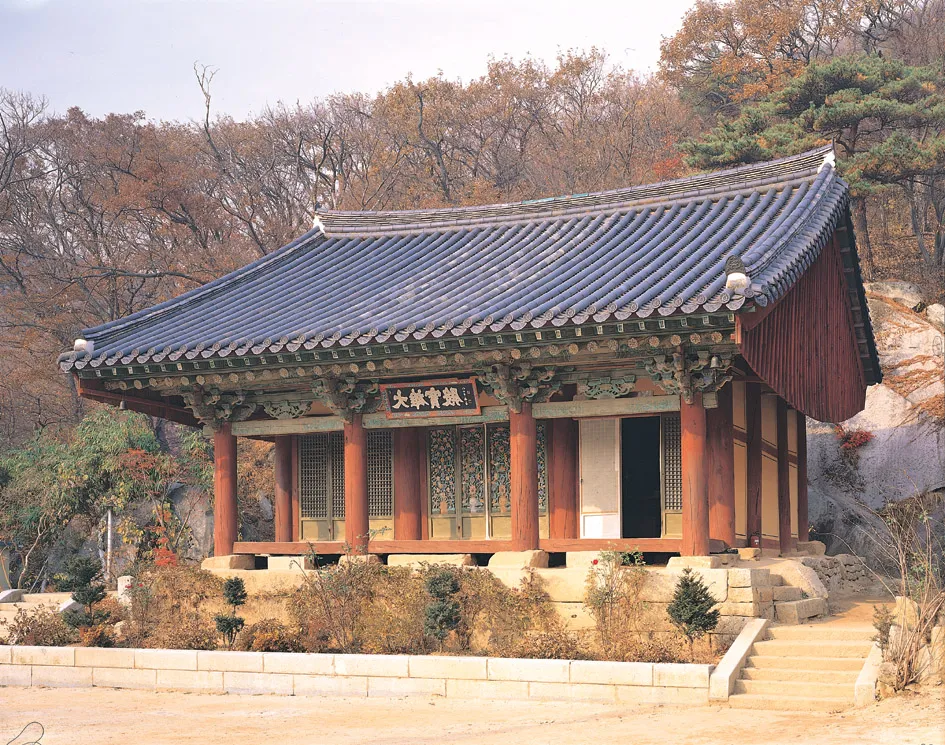
Main Buddha Hall of Jeongsusa Temple, Ganghwa
江華 淨水寺 法堂
인천광역시 강화군
Basic information
- Designation
- Treasure No.161
- Category
- Architecture
- Era
- 조선 세종 5년(1423)
- Designated year
- 1963
- Location
- 강화군, 인천광역시— 인천광역시 강화군 해안남로 1258번길 142 (화도면) / (지번)인천 강화군 화도면 사기리 산86
- Coordinates
- 37.607783, 126.445345
AI Docent
Coming soonAn AI-generated, friendly retelling of this heritage site is available in Korean. An English version is on our roadmap — for now, please see the official description below.
Description
According to a written record written discovered during repair work in 1957 and dated 1689 (the 15th year of the reign of King Sukjong of the Joseon Dynasty), the main Buddha hall of Jeongsusa Temple, Ganghwa, which enshrines the Sakyamuni Buddha statue, was renovated in 1423 (the 5th year of the reign of King Sejong). Jeongsusa Temple was originally built by a Buddhist monk named Hoejeong in 639 (the 8th year of the reign of Queen Seondeok of the Silla Dynasty), and was later rebuilt by another Buddhist master called Hamheo in 1426 (the 8th year of the King Sejong of the Joseon Dynasty). Hamheo renamed the temple Jeongsusa (Clean Water) Temple as a clean stream flows to the west of the temple. The main temple building measures 3 kan (a unit of measurement referring to the distance between two columns) at the front and 4 kan at the sides, although it used to be bigger, as originally it measured 3 kan at both the front and sides. The hall has a gable roof, which resembles the Chinese character ‘人’ when viewed from the side. The eaves of the roof are supported by a system of brackets, which are only fitted on the top of the columns, a construction technique called “the bracket on the column system”. The corridor running along the front of the building seems to be a more recent addition. The rooms, and more particularly the doors, are splendidly carved with flower patterns, attesting to the artistic mastery of the carvers.
Location
지도를 불러오는 중…
Have you visited this place?
Log in and verify your visit on-site via GPS to record a stamp in My Journey. (QR verification coming later.)
Images: KOGL (khs.go.kr) · Data source: Korea Heritage Service Open API (khs.go.kr)