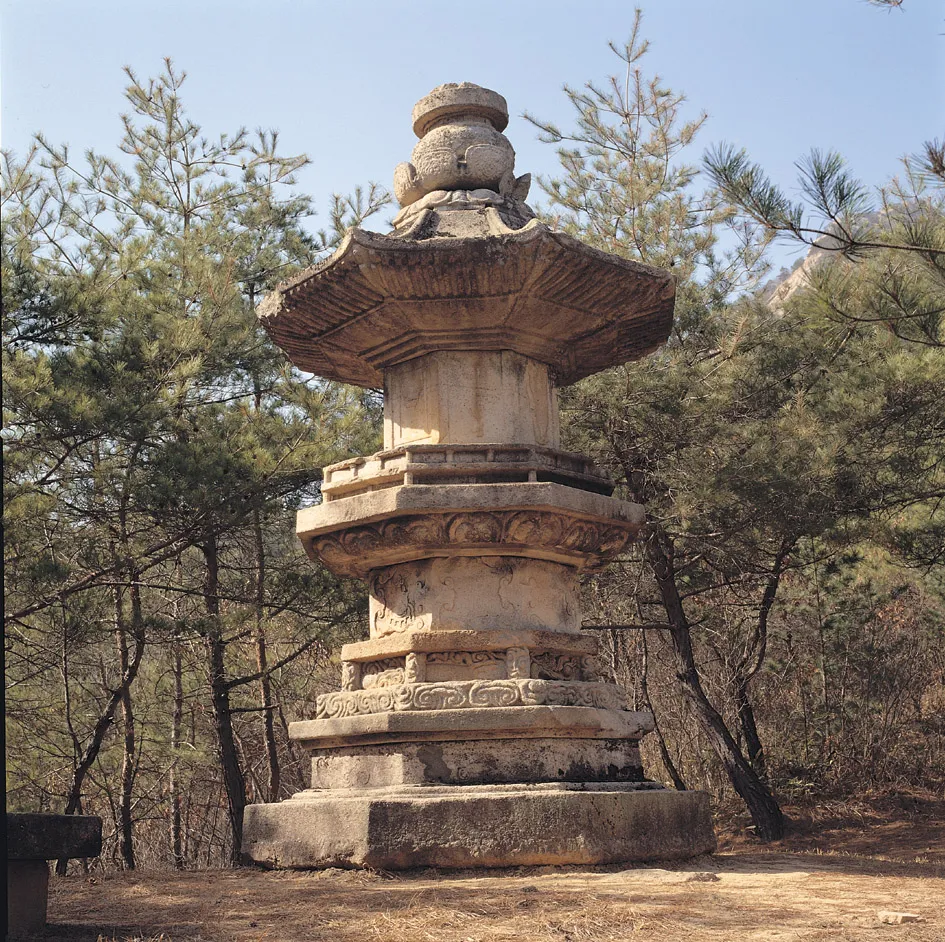
Stupa of Buddhist Monk Jeongjin at Bongamsa Temple, Mungyeong
聞慶 鳳巖寺 靜眞大師塔
경상북도 문경시
Basic information
- Designation
- Treasure No.171
- Category
- Sites & Pagodas
- Era
- 고려 광종 16년( 965)
- Designated year
- 1963
- Location
- 문경시, 경상북도— 경북 문경시 가은읍 원북리 산1-1번지 봉암사
- Coordinates
- 36.701350, 128.010179
AI Docent
Coming soonAn AI-generated, friendly retelling of this heritage site is available in Korean. An English version is on our roadmap — for now, please see the official description below.
Description
Erected to commemorate the Buddhist monk Jeongjin in 965 (the 16th year of the reign of King Gwangjong of Goryeo), this stupa sits in a picturesque site on the northern side of the mountain at the entrance to Bongamsa Temple. Buddhist monk Jeongjin (878-956) practiced asceticism at Gaechosa Temple in 897 (the 1st year of the reign of King Hyogong of the Unified Silla Period), went to Tang of China in 899 (the 3rd year of the reign of King Hyogong), and returned home in 924 (the 1st year of the reign of King Gyeongae). He stayed at Baegamsa Temple for a while before moving on to Bongamsa Temple, which flourished under his tutelage. The stupa is octagonal in shape, and consists of a stylobate which supports the main body, which is engraved with splendid Buddhist designs including flower, cloud, dragon, and lotus flower patterns. Each corner of the tall octagonal core stone is carved with a pillar pattern, while only the front face is engraved with a lock design. The roof stone looks rather thick and heavy. The lotus bud ornament is the only part that remains of the finial. This stupa imitates the style of the Monastic Stupa for Buddhist Priest Jijeung within the temple, but it is inferior in terms of its basic structure, proportions, and sculptural technique. Although overall it resembles the Stupa of Buddhist Monk Jijeung at Bongamsa Temple, this stupa displays a simpler construction style and sculpting technique.
Location
지도를 불러오는 중…
Have you visited this place?
Log in and verify your visit on-site via GPS to record a stamp in My Journey. (QR verification coming later.)
Images: KOGL (khs.go.kr) · Data source: Korea Heritage Service Open API (khs.go.kr)