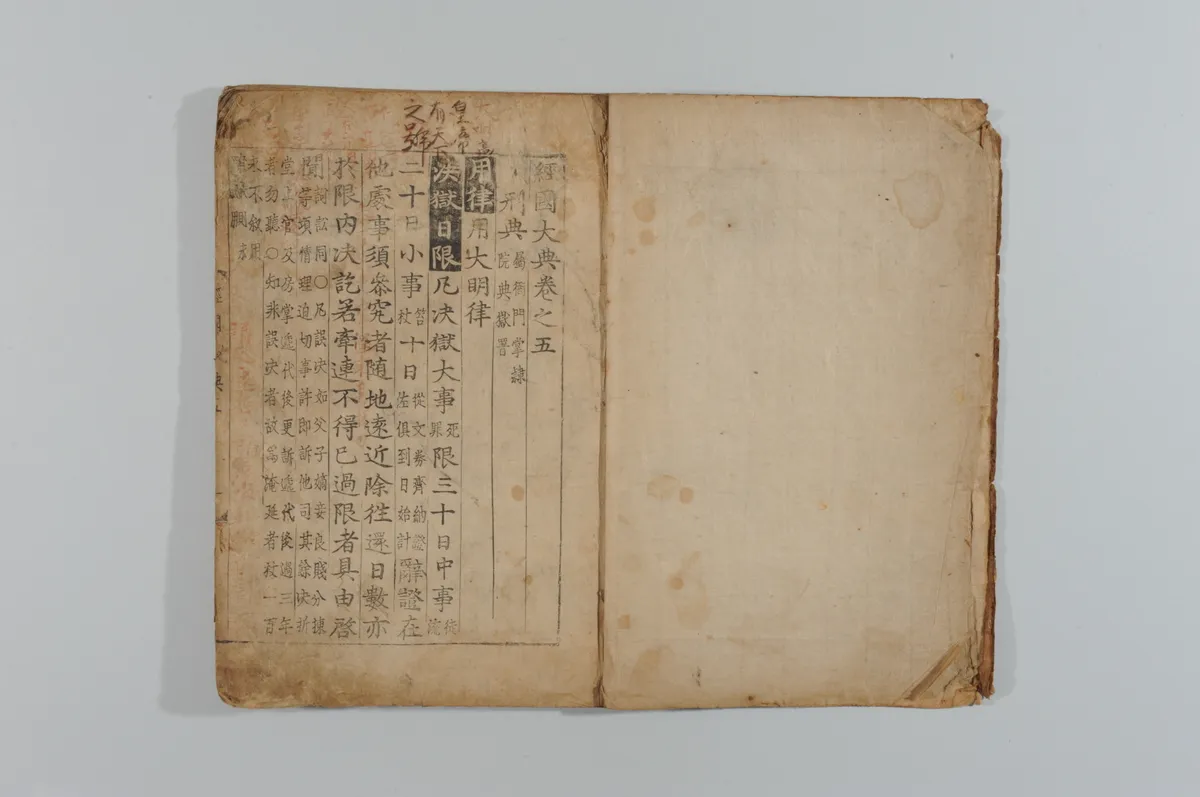
Gyeonggukdaejeon Gwon4∼6
經國大典 卷四∼六
경기도 수원시
Basic information
- Designation
- Treasure No.2171
- Category
- Books & Records
- Era
- 조선16세기
- Designated year
- 2022
- Location
- 수원시, 경기도— 경기도 수원시 팔달구 창룡대로 21 (매향동, 수원화성박물관)
- Coordinates
- 37.282675, 127.019002Kakao address conversion
AI Docent
Coming soonAn AI-generated, friendly retelling of this heritage site is available in Korean. An English version is on our roadmap — for now, please see the official description below.
Description
Machine-translatedThis English description was machine-translated and may contain inaccuracies. Refer to the original Korean text for details.
The Gyeonggukdaejeon (National Code), officially promulgated in 1485 (the sixteenth year of King Seongjong's reign), is the supreme written legal code that established the fundamental governing system of the Joseon dynasty. Its compilation was ordered in 1455 (the year of King Sejo's accession) and entrusted to scholars including Choe Hang, No Sasin, and Seo Geojong; following several rounds of revision and supplementation, the so-called 'Eulsa Daejeon' was completed in 1485. From its completion until the late Joseon period, the Gyeonggukdaejeon served as Joseon's most fundamental legal code and was applied without alteration of its provisions. It is therefore an extraordinarily valuable document for research into the legal and institutional history of the early Joseon period, as well as an important resource for bibliographical studies. The copy held at Suwon Hwaseong Museum (accession number Guip 1302) is a printing made with the Choju Gabin type mixed with supplementary type (choju gabin ja honip boja bon), produced in the sixteenth century (during the reigns of Jungjong to Myeongjong). It corresponds to three volumes (gwon 4-6) in two bound books of the Eulsa Daejeon: gwon 4 (Military Code, Byeongjeon), gwon 5 (Penal Code, Hyeongjeon, and Limits on Slave Litigation, Nobi Gyeolsong Jeonghap), and gwon 6 (Engineering Code, Gongjeon). No earlier printing of the Eulsa Daejeon than this copy has been identified to date, confirming its exceptional rarity and bibliographical significance.
Location
지도를 불러오는 중…
Have you visited this place?
Log in and verify your visit on-site via GPS to record a stamp in My Journey. (QR verification coming later.)
Images: KOGL (khs.go.kr) · Data source: Korea Heritage Service Open API (khs.go.kr)