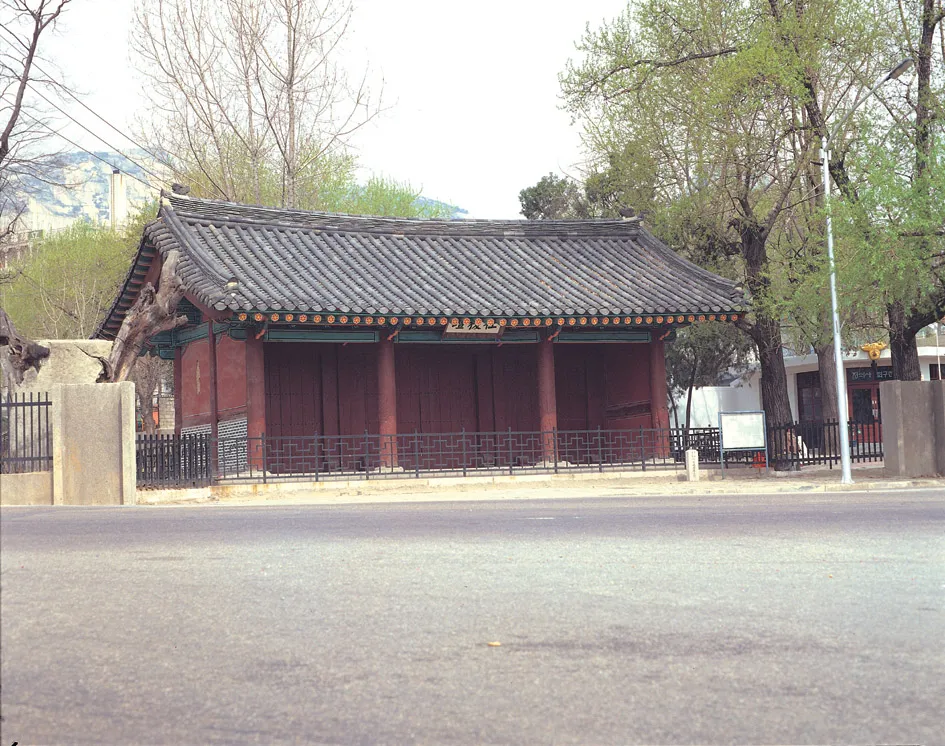
Main Gate of Sajikdan Altar, Seoul
社稷壇 大門
서울특별시 종로구
Basic information
- Designation
- Treasure No.177
- Category
- Architecture
- Era
- 조선시대 중기
- Designated year
- 1963
- Location
- 종로구, 서울특별시— 서울 종로구 사직동 1-38번지
- Coordinates
- 37.575702, 126.968632
AI Docent
Coming soonAn AI-generated, friendly retelling of this heritage site is available in Korean. An English version is on our roadmap — for now, please see the official description below.
Description
Sajikdan Altar is an ancient altar for memorial services whose name, ‘Sajikdan,’ means to ‘pray for the comfort and prosperity of the country and its people.’ The syllable 'sa' of Sajikdan refers to the country's deities, while 'jik' refers specifically to agricultural deities. Ceremonies were held at Sajikdan Altar whenever a major national event occurred as well as in times of drought. The main gate of Sajikdan Altar was built at the time of the altar’s construction in 1394 (the 3rd year of the reign of King Taejo of the Joseon Dynasty). However, it was burnt during the Japanese Invasion of Korea in 1592. According to Joseon wangjo sillok (Annals of the Joseon Dynasty), the structure was rebuilt in 1720 (the 46th year of the reign of King Sukjong) after the Japanese Invasion in 1592. The building was moved to a spot some 14 meters behind its original location in 1962 due to city planning reforms in Seoul. The gate measures 3 kan (a unit of measurement referring to the distance between two columns) at the front side and 2 kan at the sides. It has a gable roof that resembles a 人 in shape when viewed from the side. The decorative structure supporting the eaves was made using a framework resembling a bird’s beak to support the beam on top of the column. With its simple techniques and strong structure, the main gate of Sajikdan Alter adds a compact feeling to the overall form of the building, and is regarded as an important architectural and cultural asset of Korea.
Location
지도를 불러오는 중…
Have you visited this place?
Log in and verify your visit on-site via GPS to record a stamp in My Journey. (QR verification coming later.)
Images: KOGL (khs.go.kr) · Data source: Korea Heritage Service Open API (khs.go.kr)