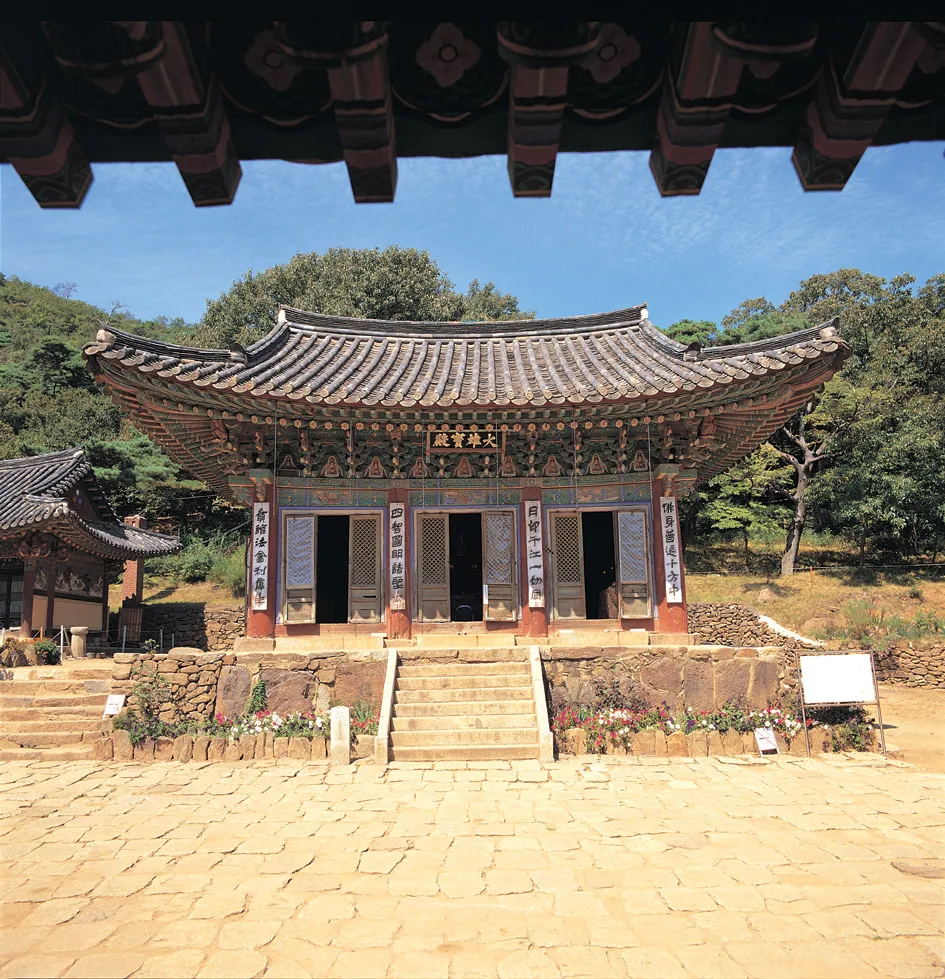
Daeungjeon Hall of Jeondeungsa Temple, Ganghwa
江華 傳燈寺 大雄殿
인천광역시 강화군
Basic information
- Designation
- Treasure No.178
- Category
- Architecture
- Era
- 조선 광해군 13년(1621)
- Designated year
- 1963
- Location
- 강화군, 인천광역시— 인천 강화군 길상면 전등사로 37-41, 전등사 (온수리) / (지번)인천 강화군 길상면 온수리 635 전등사
- Coordinates
- 37.632094, 126.484766
AI Docent
Coming soonAn AI-generated, friendly retelling of this heritage site is available in Korean. An English version is on our roadmap — for now, please see the official description below.
Description
Daeungjeon Hall is located at Jeondeungsa Temple, which is thought to have been built by the Buddhist monk Ado in 381 (the 11th year of the reign of King Sosurim of Goguryeo). However, very little is known about the history of the building prior to the mid-Goryeo period. It is said that the entire temple was burnt to the ground by two large fires in 1605 (the 38th year of the reign of King Seonjo of the Joseon Dynasty) and in 1614 (the 6th year of the reign of King Gwanghaegun of the Joseon Dynasty), that reconstruction work was begun the following year, and that the temple regained its original appearance in 1621 (the 13th year of the reign of King Gwanghaegun). Daeungjeon Hall, which enshrines the Sakyamuni Buddha Triad, was rebuilt in 1621(the 13th year of the reign of King Gwanghaegun). The hall measures 3 kan (a unit of measurement referring to the distance between two columns) at the front and 3 kan on the sides, and has a hip-and-gable roof resembling the character 八 when viewed from the side. The eaves of the roof are supported by a bracket system consisting of decorated brackets placed on and between the columns. The upper parts of the four pillars supporting the eaves are decorated with naked figures. There is an interesting legend that one of the naked persons was the hostess of an inn who stole the property of the carpenter who was responsible for the construction work. The carpenter, having been robbed of his possessions, carved a figure of a naked woman to support the eaves as a warning to the hostess to atone for her sins. An even more interesting detail is that the figure of the naked woman supports the eaves by placing one of her hands under three corners of the eaves, and only one hand under the remaining corner. It seems as if she is scheming even while receiving punishment, showing our ancestors' wit and humor. Owing to the skillful carving technique applied to Daeungjeon Hall, it is considered an important material for research on the history of architecture and construction after the mid-Joseon Period.
Location
지도를 불러오는 중…
Have you visited this place?
Log in and verify your visit on-site via GPS to record a stamp in My Journey. (QR verification coming later.)
Images: KOGL (khs.go.kr) · Data source: Korea Heritage Service Open API (khs.go.kr)