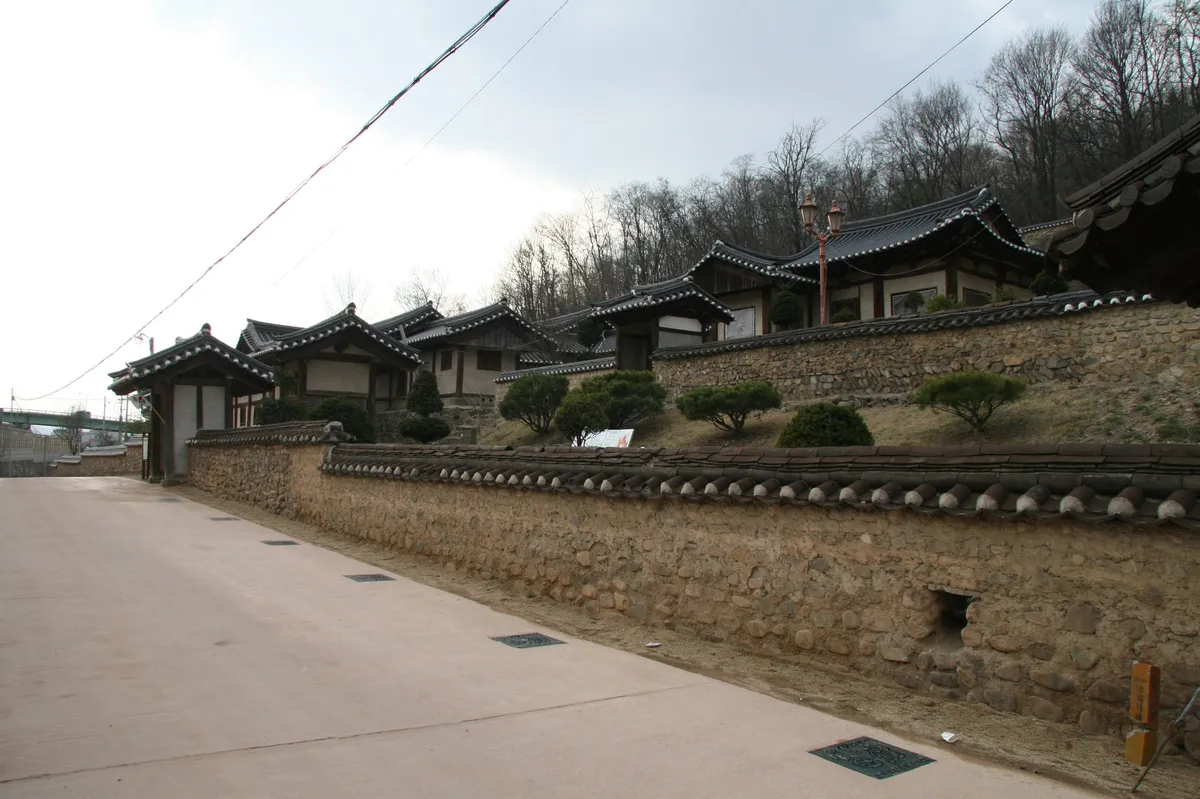
Imcheonggak House, Andong
安東 臨淸閣
경상북도 안동시
Basic information
- Designation
- Treasure No.182
- Category
- Architecture
- Era
- 조선 중종 14년(1519년)
- Designated year
- 1963
- Location
- 안동시, 경상북도— 경북 안동시 임청각길 53 (법흥동)
- Coordinates
- 36.565113, 128.744691
AI Docent
Coming soonAn AI-generated, friendly retelling of this heritage site is available in Korean. An English version is on our roadmap — for now, please see the official description below.
Description
Imcheonggak House was built by Yi Myeong, a high-ranking official of the Ministry of Justice, in 1515 (the 10th year of the reign of King Jungjong of the Joseon Dynasty, and was also inhabited by Lee Sang-ryong, the third president of the Provisional Government of the Republic of Korea in Shanghai. This house is located on the eastern slope of Yeongnamsan Mountain and faces the Nakdonggang River, in what is, according to feng shui theory, a propitious south-facing site with a mountain to its rear and a river flowing before it. During the construction of the Central Railway Line, some fifty buildings of the servant’s quarters and various attached houses were torn down, thus reducing the scale of the house to its current size; however, with the remaining houses around the main gate, Imcheonggak House has retained a spectacular appearance nonetheless. Designated as a treasure in recognition of its well-preserved state, Gunjajeong Pavilion was the detached quarters of Imcheonggak House. It is a T-shaped measuring three kan (a unit of measurement referring to the distance between two columns) at the front and two at the sides, and has a hip-and-gable roof resembling the character 八 when viewed from the side. It has four rooms, including a south-facing vestibule at the center of the building, and a T-shaped room with a Korean under-the-floor heating system in the western part. A narrow wooden porch and a handrail run around the exterior of the building, and there are two sets of stone stairs serving as entrances to the building.
Location
지도를 불러오는 중…
Have you visited this place?
Log in and verify your visit on-site via GPS to record a stamp in My Journey. (QR verification coming later.)
Images: KOGL (khs.go.kr) · Data source: Korea Heritage Service Open API (khs.go.kr)