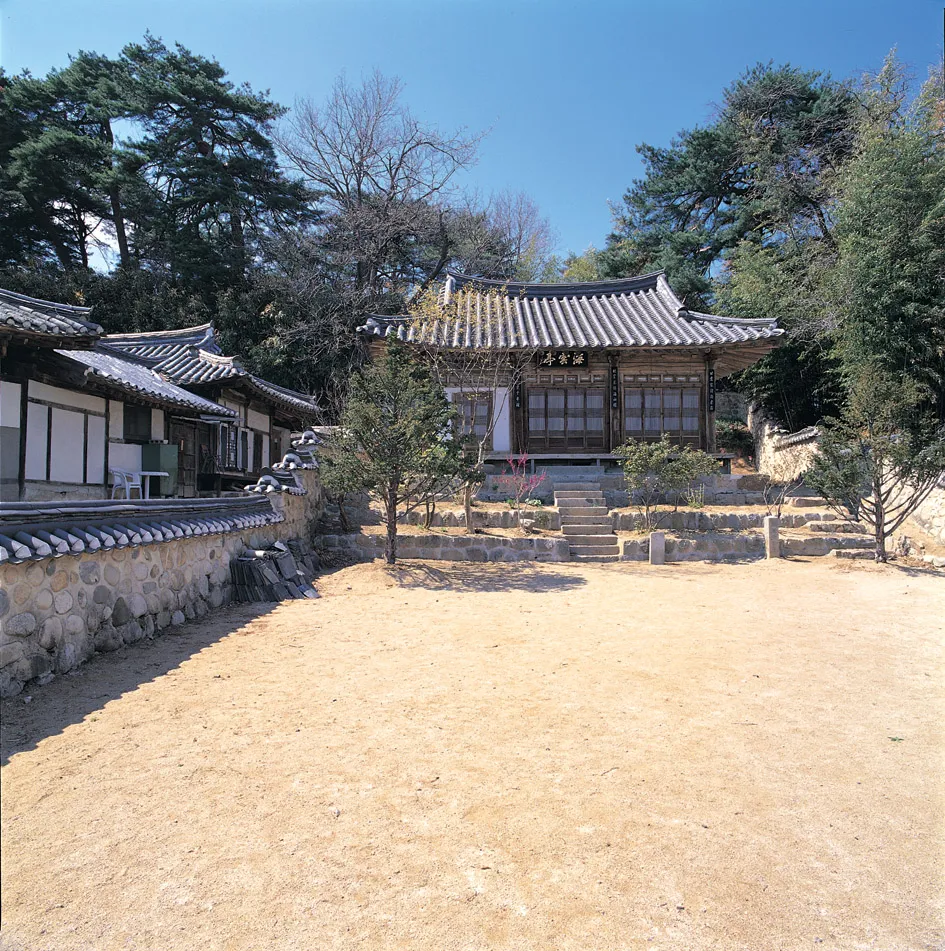
Haeunjeong Pavilion, Gangneung
江陵 海雲亭
강원특별자치도 강릉시
Basic information
- Designation
- Treasure No.183
- Category
- Architecture
- Era
- 조선 중종 25년(1530)
- Designated year
- 1963
- Location
- 강릉시, 강원특별자치도— 강원 강릉시 운정길 125 (운정동)
- Coordinates
- 37.786200, 128.891155
AI Docent
Coming soonAn AI-generated, friendly retelling of this heritage site is available in Korean. An English version is on our roadmap — for now, please see the official description below.
Description
Haeunjeong Pavilion, a separate building of an upper-class residence of the Joseon Dynasty, commands a view of Gyeongpoho Lake. It is believed that Sim Eon-gwang, going under the pseudonym Eochon, constructed the pavilion in 1530 (the 25th year of the reign of King Jeongjong of the Joseon Dynasty) while serving as the Governor of Gangwon-do. Sim Eon-gwang, who was an excellent writer, passed the preliminary examination for the civil service in 1507 (the 2nd year of the reign of King Jungjong) and subsequently occupied several government positions. The pavilion was built on a three-tiered embankment facing south, and measures three kan (a unit of measurement referring to the distance between two columns) at the front and two at the sides. On the right inside the building is a vestibule measuring two kan, while on the left is a room with under-the-floor heating measuring one kan. The pavilion has a hip-and-gable roof resembling the character 八 when viewed from the side. All the doors at the front of the vestibule can be opened; and there is a narrow wooden porch running along the outside of the building. The hanging board of Haeunjeong Pavilion was written by Song Si-yeol, one of the greatest Confucian scholars of the Joseon Dynasty. The interior of the pavilion features inscriptions by famous people including Gwon Jin-eung and Yi I. The pavilion’s interior is decorated with refined carving techniques, while its exterior features simple decoration. Haeunjeong Pavilion is the second oldest building in Gangneung after Ojukheon House.
Location
지도를 불러오는 중…
Have you visited this place?
Log in and verify your visit on-site via GPS to record a stamp in My Journey. (QR verification coming later.)
Images: KOGL (khs.go.kr) · Data source: Korea Heritage Service Open API (khs.go.kr)