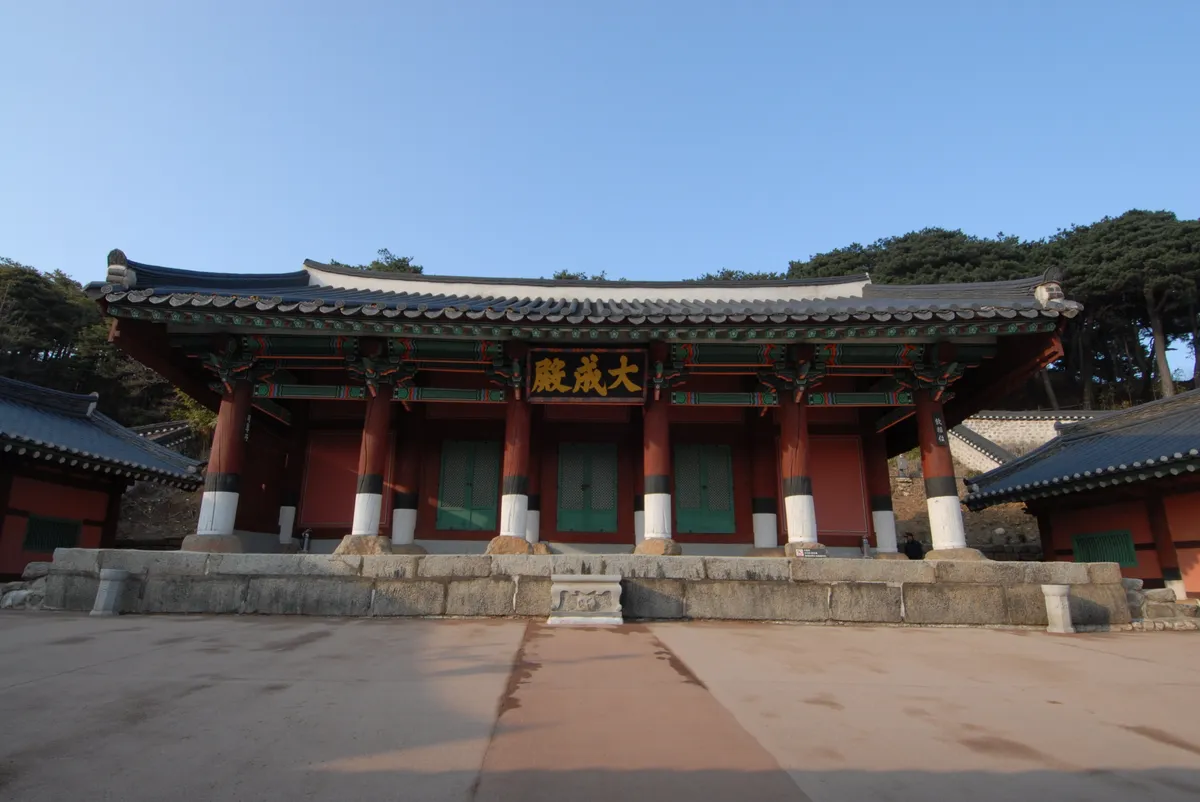
Daeseongjeon Shrine of Gangneunghyanggyo Local Confucian School
江陵鄕校 大成殿
강원특별자치도 강릉시
Basic information
- Designation
- Treasure No.214
- Category
- Architecture
- Era
- 조선 태종 13년(1413)
- Designated year
- 1963
- Location
- 강릉시, 강원특별자치도— 강원 강릉시 명륜로 29 (교동)
- Coordinates
- 37.763559, 128.895268
AI Docent
Coming soonAn AI-generated, friendly retelling of this heritage site is available in Korean. An English version is on our roadmap — for now, please see the official description below.
Description
The hyanggyo (meaning 'local Confucian school’) in Gangneung was built by Kim Seung-in, governor of Gangneung, in 1313, the 5th year of the reign of King Chungseon of Goryeo. Once used to hold commemorative services for respected Confucian scholars and to deepen the world of learning. It was burnt down in the 11th year of the reign of King Taejong of Joseon (1414), but was rebuilt by Yi Maeng-sang, vice governor of Gangneung, after two years later, followed by numerous repairs. The Daeseongjeon Shrine refers to the main building of such places for holding a memorial service for respected Confucian scholars. The shrine at this particular hyanggyo was built in 1413, 13th year of King Taejong. This shrine is dedicated to some of the most respected Confucian scholars including Confucius himself and his disciples and students, and houses their mortuary tablets. It measures five kan (a unit of measurement referring to the distance between two columns) in the front and three on the side under a hip-and-gable roof. The roof is made in the jusimpo style, and only one bracket is inserted between the rafter and column to support the roof. Inside the building, the floor is made of flagstones and the ceiling is decorated with lotus lamps which are transparent enough make the rafter visible. The simplicity and refinement of the style in this ancient Confucian school are what make this ancient architecture of the Goryeo period particularly important. In addition to commemorative services, it also retained its original purpose of a local school for a great number of noblemen and scholars in this region.
Location
지도를 불러오는 중…
Have you visited this place?
Log in and verify your visit on-site via GPS to record a stamp in My Journey. (QR verification coming later.)
Images: KOGL (khs.go.kr) · Data source: Korea Heritage Service Open API (khs.go.kr)