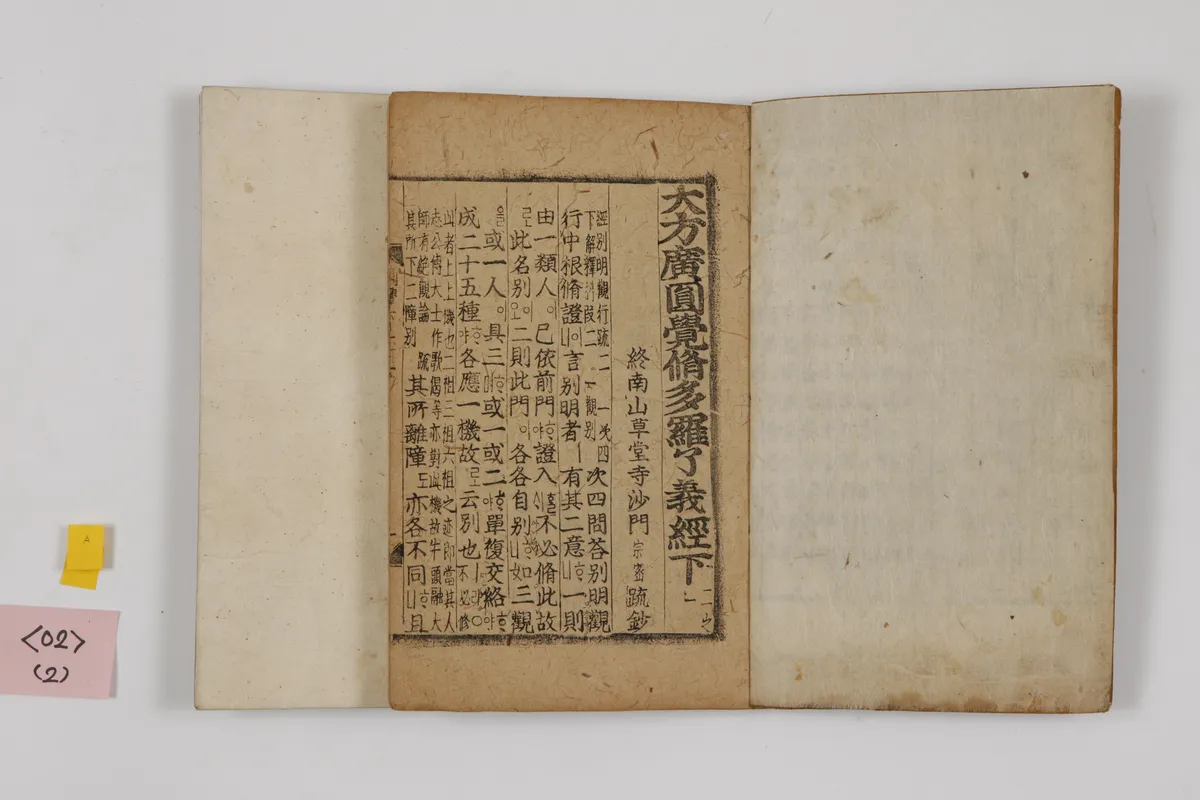
Daebanggwangwongaksudarayouigyeong(eonhae) Gwonha1ui1~2, 2ui1~2
大方廣圓覺脩多羅了義經(諺解) 卷下一의一~二, 二의一~二
부산광역시 사하구
Basic information
- Designation
- Treasure No.1219-3
- Category
- Books & Records
- Designated year
- 2015
- Location
- 사하구, 부산광역시— 부산광역시 사하구 제석로79번길 33 (당리동, 관음사)
- Coordinates
- 35.109090, 128.975778Kakao address conversion
AI Docent
Coming soonAn AI-generated, friendly retelling of this heritage site is available in Korean. An English version is on our roadmap — for now, please see the official description below.
Description
Machine-translatedThis English description was machine-translated and may contain inaccuracies. Refer to the original Korean text for details.
'Great Universal Circle-Awakening Enlightenment Scripture (Korean Vernacular Translation)' volumes below (1-2), 2 (1-2) was rendered in metallic type from a Korean vernacular translation manuscript prepared from the Scriptural Printing Office's Korean translation version, using eul-yu characters cast at the Foundry Office in the eleventh year of King Sejong's reign (1465). The text was translated from Sanskrit by Buddhatara and annotated by Zongmi (780-841). The format features single-line borders on all four sides with a half-frame dimension of 19.5 x 13.4cm, including boundary lines with six lines of text per half-leaf in the main body and double lines for annotations. The fish-tail decorations are inward-pointing black fish-tails, the colophon title reads 'Circle-Awakening,' and the book measures 26.2 x 13.5cm with line-bound binding. The eul-yu type was primarily cast for printing Buddhist scriptures but due to strong opposition from Confucian officials, it remained unused for extended periods and was later melted down for the production of gapjin type. Consequently, relatively few transmitted copies exist, making this a rare and valuable edition highly regarded for its rarity. This work constitutes precious research material for Korean linguistics and metallic type studies during the Joseon era.
Location
지도를 불러오는 중…
Have you visited this place?
Log in and verify your visit on-site via GPS to record a stamp in My Journey. (QR verification coming later.)
Images: KOGL (khs.go.kr) · Data source: Korea Heritage Service Open API (khs.go.kr)