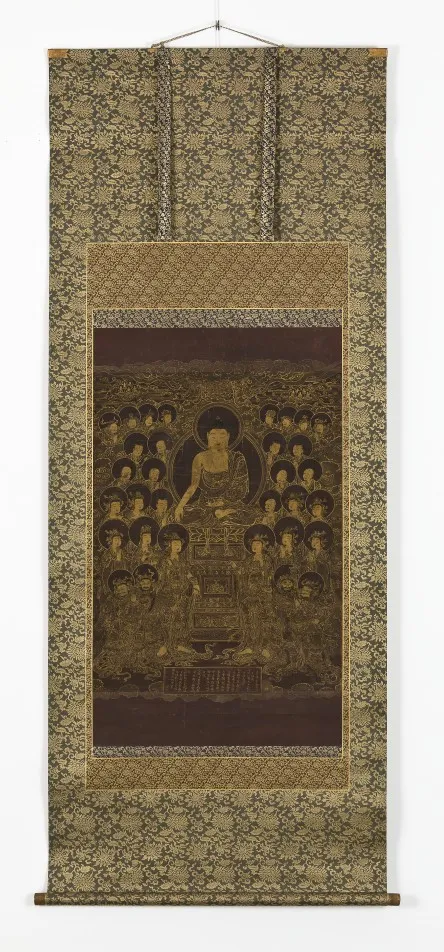
Yeongsanhoesangdo(2025)
靈山會上圖(2025)
서울특별시 종로구
Basic information
- Designation
- Treasure No.2304
- Category
- Painting
- Era
- 1560년(조선 명종 15)
- Designated year
- 2025
- Location
- 종로구, 서울특별시— 서울특별시 종로구
- Coordinates
- 37.574773, 126.979614
AI Docent
Coming soonAn AI-generated, friendly retelling of this heritage site is available in Korean. An English version is on our roadmap — for now, please see the official description below.
Description
Machine-translatedThis English description was machine-translated and may contain inaccuracies. Refer to the original Korean text for details.
A privately-held 'Shakyamuni's Assembly on Vulture Peak' is a Buddhist painting whose production date of 1560 (Myeongjeong 15), purpose of ensuring the royal family's longevity and descendant prosperity, patron sponsor Queen Munjeong, and subject matter are all clearly documented in the painting's inscription. Rendered on silk with gold-lined pigments, the composition depicts the moment when Shakyamuni Buddha delivers the Lotus Sutra on Vulture Peak, with the principal Buddha centrally positioned and surrounded by six bodhisattvas, Indra and Brahma, the Four Heavenly Kings, and the eight dharma protectors arranged in well-organized hierarchical composition. The concise, refined circular halos and body halos, high ushnisha topped with sharp pearl-finials, small refined facial features, well-balanced bodies without excessive flesh, and the teaching gesture mudra positioned at the right knee edge exemplify 16th-century Buddhist painting style. Among multi-figure assembly paintings produced in early Joseon, this work exhibits exceptional compositional mastery and meticulous expression, demonstrating outstanding artistic merit. As a royal-commissioned Buddhist painting, this work possesses important historical significance, and the clearly documented 1560 production date and painting title constitute a crucial reference for studying early Joseon Buddhist painting and Shakyamuni's Assembly iconography. The composition featuring Shakyamuni Buddha centrally positioned with six bodhisattvas, ten principal disciples, Four Heavenly Kings, eight dharma protectors, and royal couple represents the conservative ancient style that later became the standard composition for Joseon period assembly paintings.
Location
지도를 불러오는 중…
Have you visited this place?
Log in and verify your visit on-site via GPS to record a stamp in My Journey. (QR verification coming later.)
Images: KOGL (khs.go.kr) · Data source: Korea Heritage Service Open API (khs.go.kr)