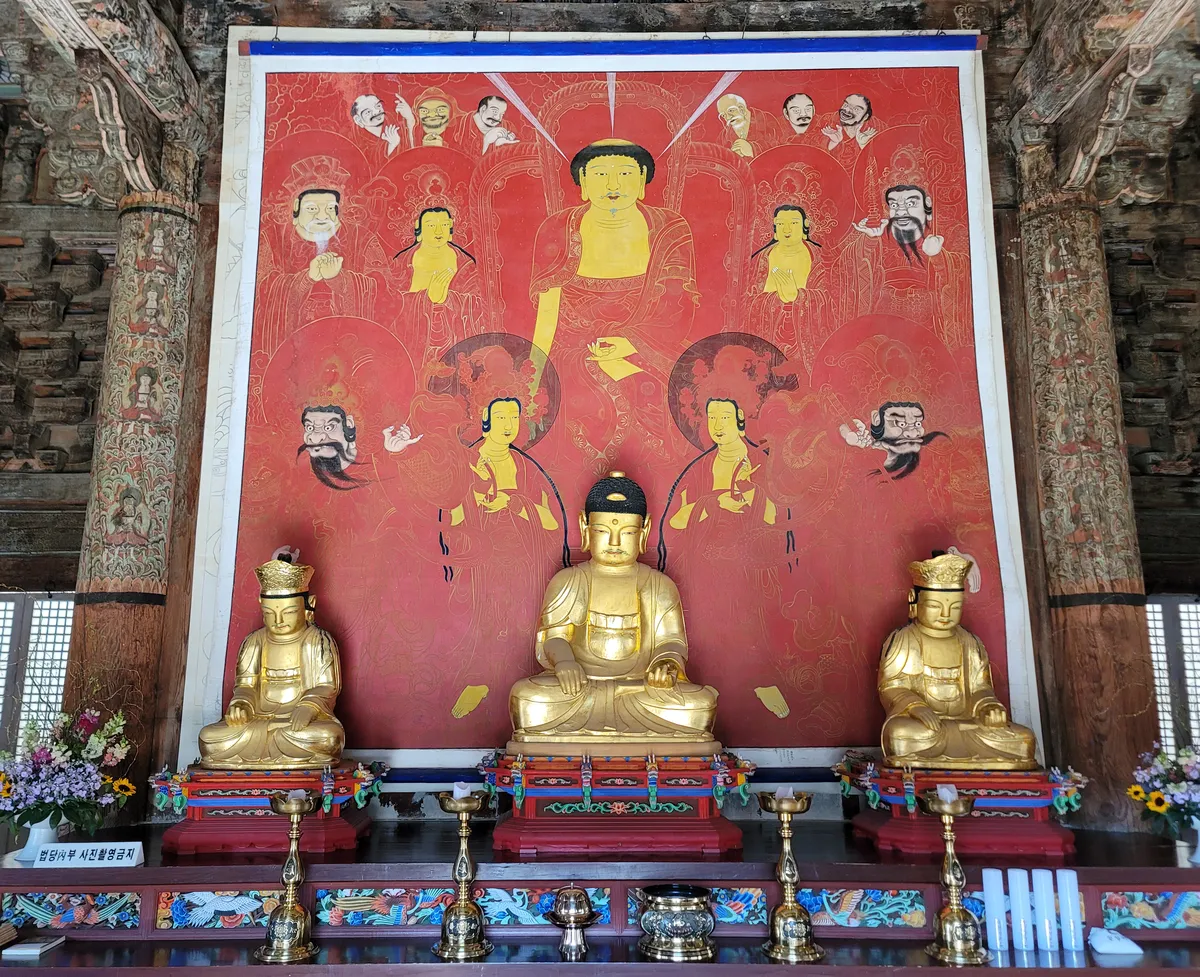
Sinheungsa Seokjoseokgayeoraesamjonjwasang Mit Reliquary Objects, Yangsan
梁山 新興寺 石造釋迦如來三尊坐像 및 腹藏遺物
경상남도 양산시
Basic information
- Designation
- Treasure No.2312
- Category
- Sculpture
- Era
- 불 상-1682년(조선 숙종 8), 복장유물-고려 후기~조선시대(14~17세기)
- Designated year
- 2026
- Location
- 양산시, 경상남도— 경상남도 양산시 원동로 2282-111(원동면, 신흥사)
- Coordinates
- 38.125500, 128.464300Museum-based location
AI Docent
Coming soonAn AI-generated, friendly retelling of this heritage site is available in Korean. An English version is on our roadmap — for now, please see the official description below.
Description
Machine-translatedThis English description was machine-translated and may contain inaccuracies. Refer to the original Korean text for details.
The 'Stone Buddha Triad of Shakyamuni and Associated Consecration Relics from Sinhung Temple in Yangsan' were completed in 1682 (Sukjong 8) by sculptor-monks including Seung-ho as principal sculptor, along with Suyeon, Bojang, Inwon, and Cheohaeng, and enshrined at Sinhung Temple. This production information is documented through a creation vow inscription discovered in the right-hand bodhisattva figure, which additionally identifies this triad as 'The Assembly on Vulture Peak Buddha Triad.' The designated work was sculpted in Buddha stone, a material extensively employed for numerous sculptures such as underworld king statues and Arhat figures following the 17th century. Seung-ho, who directed the composition, was a sculptor-monk whose activities were particularly prominent in the Gyeongbuk region and expertly manipulated Buddha stone, with his surviving works predominantly composed of this material. Seung-ho had previously assisted Dou in producing the stone Buddha Amitabha triad at Songrim Temple in Chilgok in 1655 (Hyojong 6), where he acquired Buddha stone handling techniques, subsequently extensively employing this material in Buddha sculpture production. The Yangsan Sinhung Temple stone Buddha Shakyamuni triad exemplifies characteristics of Buddha stone sculpture popular in this region, constituting Seung-ho's earliest documented work produced for a principal temple hall among his remaining compositions. The work possesses high art-historical and historical value through permitting understanding of late-Joseon Gyeongbuk regional sculptural practices and sculptor activities while remaining at its original enshrinement location, warranting designation as a National Treasure for preservation. Additionally, the associated consecration relics jointly deposited represent important material for understanding late-17th-century consecration practices, and the important ceremonial items such as the posterior-body cylinder originally interred during production merit designation and preservation alongside the sculpture.
Location
지도를 불러오는 중…
Have you visited this place?
Log in and verify your visit on-site via GPS to record a stamp in My Journey. (QR verification coming later.)
Images: KOGL (khs.go.kr) · Data source: Korea Heritage Service Open API (khs.go.kr)