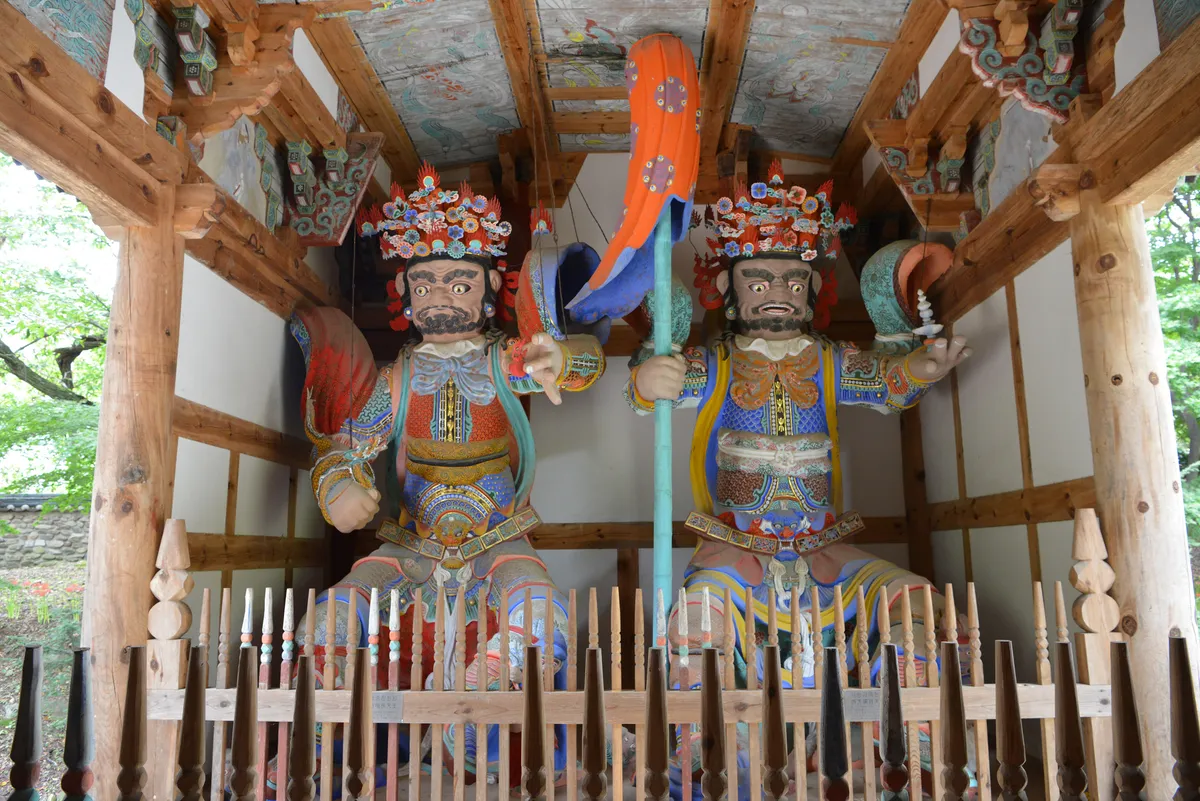
Jikjisa Sojosacheonwangsang, Gimcheon
金泉 直指寺 塑造四天王像
경상북도 김천시
Basic information
- Designation
- Treasure No.2227
- Category
- Sculpture
- Era
- 1665년(조선 현종 6)
- Designated year
- 2023
- Location
- 김천시, 경상북도— 경상북도 김천시 직지사길 95 (대항면)
- Coordinates
- 36.118500, 128.117400Museum-based location
AI Docent
Coming soonAn AI-generated, friendly retelling of this heritage site is available in Korean. An English version is on our roadmap — for now, please see the official description below.
Description
Machine-translatedThis English description was machine-translated and may contain inaccuracies. Refer to the original Korean text for details.
The Four Heavenly Kings enshrined at the temple gate are protective deities dwelling on Mount Sumeru protecting the Buddhist law and Buddhist lands from four cardinal directions, each governing their respective direction with ritual implements such as treasured swords, banners with pagodas, dragons and wish-granting jewels, and lutes. They are depicted with widely opened eyes, gaping mouths creating fearful expressions, armored bodies, and demon or spirits trampled beneath their feet. The Gimcheon Jikji-sa Four Heavenly King clay statues are notably significant in that vow documents were discovered for these statues, revealing they were created in 1665 under the direction of Dan-eung (端應), a sculptor active based in Wanju Songwang-sa, and his sculptural lineage. Until these discoveries, a significant gap existed between the Wanju Songwang-sa clay statues created in 1649 and the Suta-sa clay statues created in 1676, with no intervening works. The establishment of Jikji-sa's creation date fills this important void and provides crucial reference material for mid-17th century Four Heavenly King research. The vow documents contain information regarding sculptors' activities, making them valuable for understanding the mutual interactions and collaborative works among sculptors from Honam and Yeongnam regions, possessing considerable scholarly value for late Joseon Buddhist sculpture history research. The Jikji-sa statues follow the general late Joseon arrangement pattern with Eastern and Northern Kings positioned right of the temple gate entrance and Southern and Western Kings positioned left, but distinctively feature ink-written directional annotations on the statues themselves, finally resolving long-standing controversies regarding Four Heavenly Kings directional positioning through newly secured reference materials. The Jikji-sa statues display proportions with elongated upper bodies, and unique distinctive elements in their ritual implements. Notably, the Western King's staff features rare bamboo construction, the pagoda assumes distinctive unusual tower forms, and the Northern King's lute features a cyan lion positioned atop it, representing exceptional sculptural examples.
Location
지도를 불러오는 중…
Have you visited this place?
Log in and verify your visit on-site via GPS to record a stamp in My Journey. (QR verification coming later.)
Images: KOGL (khs.go.kr) · Data source: Korea Heritage Service Open API (khs.go.kr)