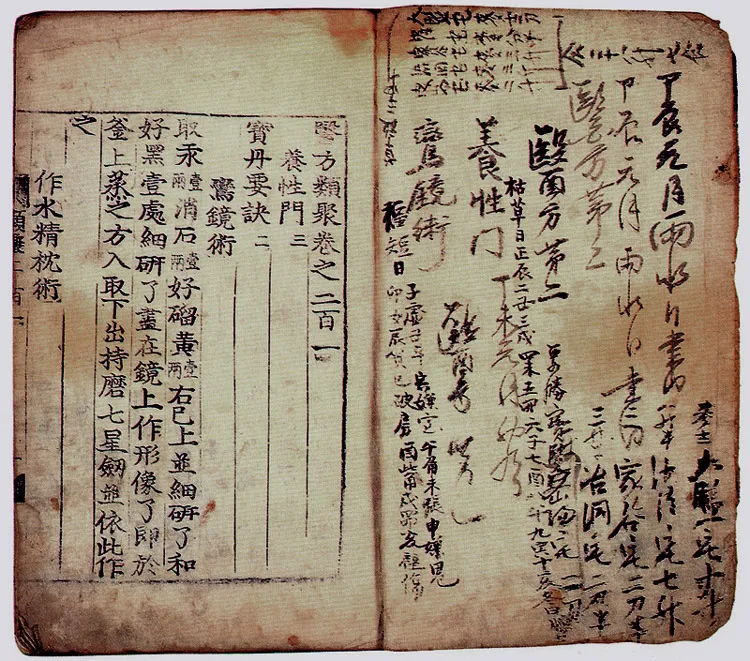
Uibangyuchwi Gwon201
醫方類聚 卷二百一
충청북도 음성군
Basic information
- Designation
- Treasure No.1234
- Category
- Books & Records
- Era
- 조선 성종 8년(1477)
- Designated year
- 1996
- Location
- 음성군, 충청북도— 충북 음성군 대소면 대풍산단로 78, 한독의약박물관 (대풍리)
- Coordinates
- 36.970886, 127.464525
AI Docent
Coming soonAn AI-generated, friendly retelling of this heritage site is available in Korean. An English version is on our roadmap — for now, please see the official description below.
Description
As an encyclopedia of Korean traditional medicine, this book was written at the King's order in the 27th year of King Sejong’s reign (1445) and was re-printed with a typeset in the 8th year of King Seongjong’s reign (1477). Prominent men of the time had participated in writing this book: Kim Ye-mong, who was the assistant chief of Jiphyeonjeon (Printing Bureau of the Joseon Dynasty), and Yu Seong-won, who was the chief reviser, collected information about medical treatments; medical official Jeon Sun-ui compiled the information into one book; Grand Prince Anpyeong and Yi Sa-cheol, who was the chief royal secretary, proofread the book. This book originally consisted of 365 volumes. After several revisions, it was compiled as 264 books in 266 volumes. In the 8th year of King Seongjong’s reign (1477), Han Gye-hui and Im Won-jun published 30 copies of these books. Since then, the books had not been published again. Most of these copies were destroyed during the Japanese Invasion of Korea in 1592. Among the entire 264 books, 252 were pillaged by a Japanese commander named Kato Kiyomasa. They are currently kept at the Library of the Imperial Household Agency of Japan and are the only copies remaining at present. This book features six medical treatment methods, such as Bodanyogyeori, Jussijipheombang, Wangssijipheombang, Suchinyangnoseo, Sarimgwanggi, and Sangeosayo. This book is regarded as a valuable material in studying the history of publication related to medical books, since it is the only copy of the first publication discovered in Korea.
Location
지도를 불러오는 중…
Have you visited this place?
Log in and verify your visit on-site via GPS to record a stamp in My Journey. (QR verification coming later.)
Images: KOGL (khs.go.kr) · Data source: Korea Heritage Service Open API (khs.go.kr)