Songgwangsa Jogye Gate, Suncheon
順天 松廣寺 曹溪門
전라남도 순천시
Basic information
- Designation
- Treasure No.2237
- Category
- Architecture
- Era
- 조선시대
- Designated year
- 2023
- Location
- 순천시, 전라남도— 전라남도 순천시 송광사안길 100 (송광면)
- Coordinates
- 34.969400, 127.087900Museum-based location
AI Docent
Coming soonAn AI-generated, friendly retelling of this heritage site is available in Korean. An English version is on our roadmap — for now, please see the official description below.
Description
Machine-translatedThis English description was machine-translated and may contain inaccuracies. Refer to the original Korean text for details.
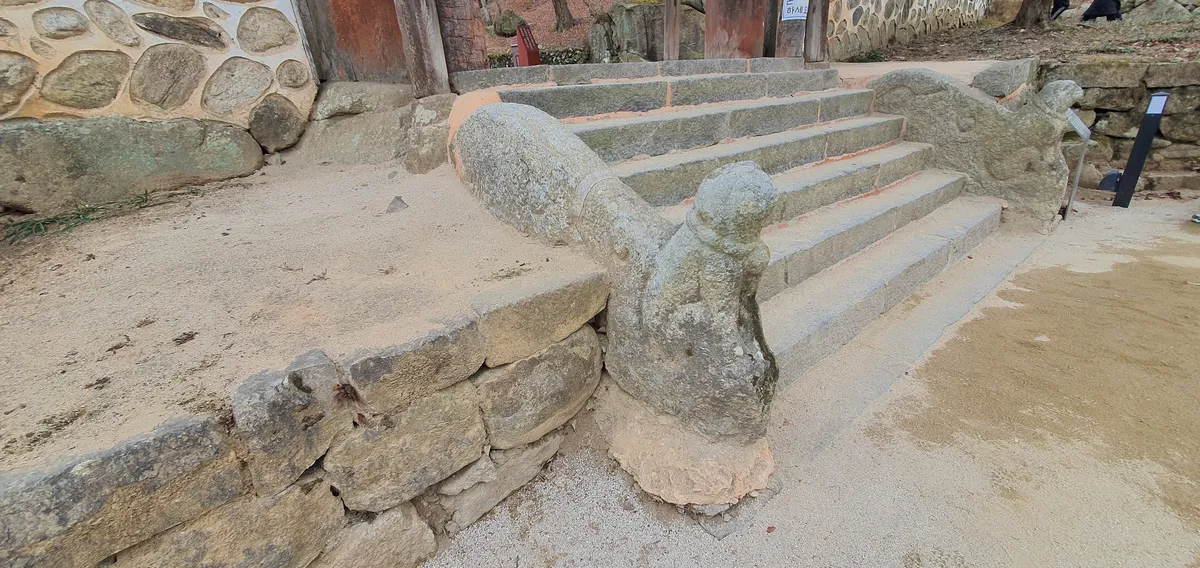
Sunwon Songkwang Temple's Jogye Gate (Jogye-mun) lacks documentation confirming construction date. However, historical records including the "History Archives of Jogye Mountain Songkwang Temple" (Jogye-san Songkwang-sa Saggo) document a 1802 (Sunjo 2nd year) reconstruction, and accounts of extensive temple fire destruction in 1842 (Heonjong 8th year) of most northwestern structures while the Jogye Gate survived establish its pre-1802 existence. These historical records confirm the gate's establishment prior to the 1802 repair date. The gate's location appears in the temple layout illustrated in the "Historical Record of Sunwon Jogye Mountain Songkwang Temple" (Sunwon Jogye-san Songkwang-sa Sagjeok) documented as 1886. The frontal facade displays vertically-oriented plaque reading "Jogye Mountain Great Mahayana Zen Songkwang Temple" (Jogye-san Daesiung Seonjong Songkwang-sa), with interior horizontal plaque inscribed "Buddhist Dharma Treasure Temple Jogye Zen Center" (Seungbo Jongjjal Jogye Chonglim). The gate's "Four-Generation Reconstruction Record" (Sagung Chang-gi) documents the designation as "Jogye Gate" (Jogye-mun). Sunwon Songkwang Temple's Jogye Gate comprises a single-bay gable-roof structure with double-eave overlapping-roof configuration. The gable-roof side wind-board is configured with straight-line lower edge treatment, effectively revealing the lateral bracket-system components. The bracket system employs five bracket members on the frontal curved-beam, with overall composition of twelve bracket members utilizing multiple-bracket system design. Auxiliary octagonal-section pillars reinforce the primary pillars at four cardinal locations: both lateral sides and front-and-rear curved-beam corners. Primary pillar interior-upper sections incorporate dragon-head ornamentation (yong-du), representing frequent late-Joseon embellishment practice. Distinctive design features include earthen-stone protective walls and connections at primary pillar locations, auxiliary pillar installations, interior dragon-head decorative embellishment, and animal-form sculptural ornaments adorning gate-approach foundation boundary stones, exemplifying regional architectural characteristics. These features collectively demonstrate the gate's regional specificity within Joseon-period single-pillar-gate architectural traditions.
Location
지도를 불러오는 중…
Have you visited this place?
Log in and verify your visit on-site via GPS to record a stamp in My Journey. (QR verification coming later.)
Images: KOGL (khs.go.kr) · Data source: Korea Heritage Service Open API (khs.go.kr)