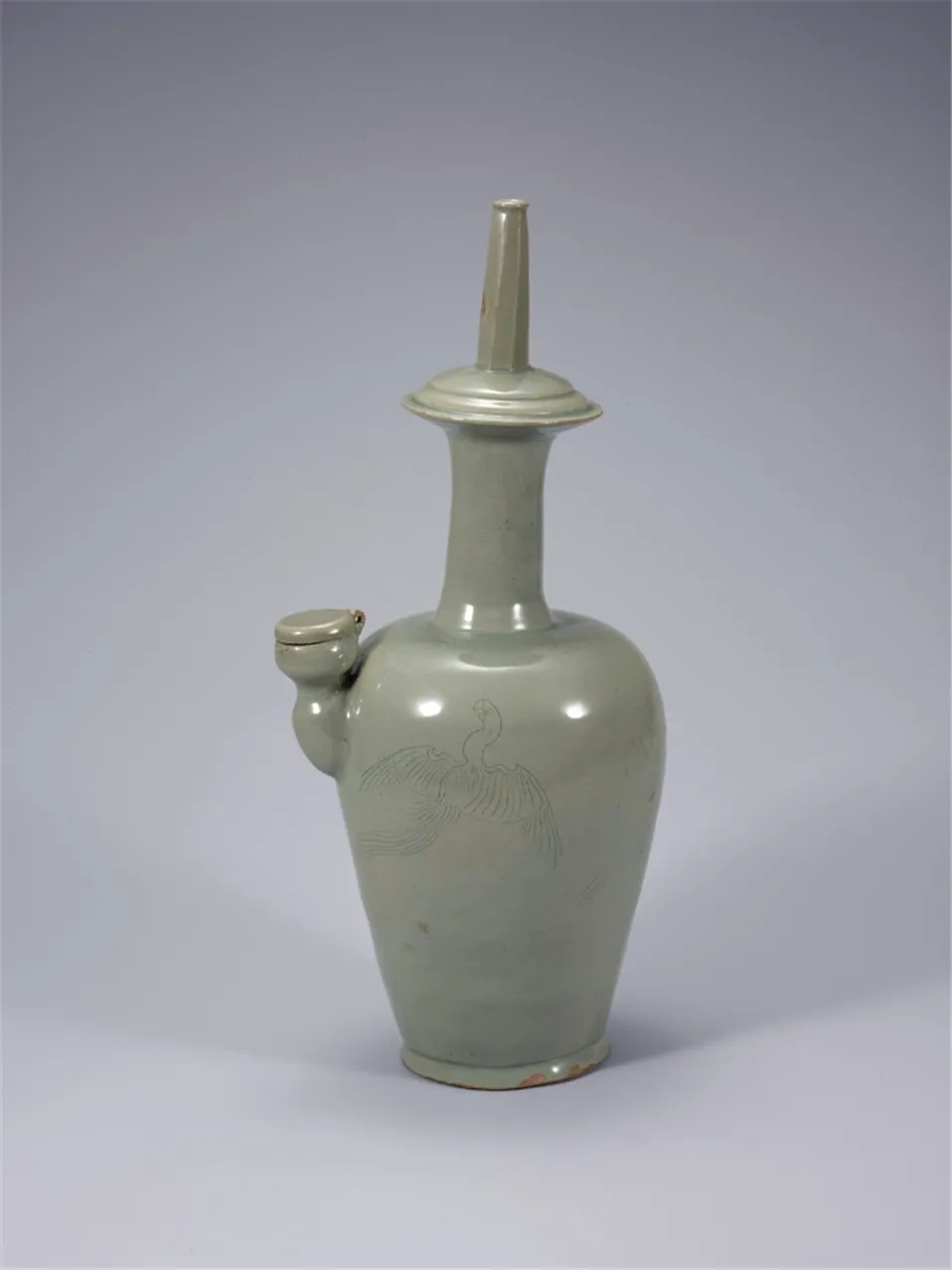
Celadon Eumgagaengmumun Kundika (Water Bottle)
靑磁 陰刻鸚鵡文 淨甁
서울특별시 중구
Basic information
- Designation
- Treasure No.2238
- Category
- Craft
- Era
- 고려시대(12세기)
- Designated year
- 2023
- Location
- 중구, 서울특별시— 서울특별시 중구
- Coordinates
- 37.563808, 126.997555
AI Docent
Coming soonAn AI-generated, friendly retelling of this heritage site is available in Korean. An English version is on our roadmap — for now, please see the official description below.
Description
Machine-translatedThis English description was machine-translated and may contain inaccuracies. Refer to the original Korean text for details.
A ewer (jung-byeong) is a water vessel used in Buddhism to hold clean water. Carried as a possession by practicing monks and presented as a Buddhist ritual offering of clean water before the Buddha, it features a bulbous body with a spout for pouring water on one side and a pointed finial for water dispensing at the top. Goryeo-period ewers were used across all social levels from the royal court to commoners, as well as in government offices, Daoist temples, and Buddhist temples, resulting in diverse quality and multiple construction materials including metal, celadon, and earthenware. The production of celadon ewers began after the 12th century. The 'Celadon Ewer with Parrot Incised Design' demonstrates exceptional preservation without repairs, excellent glaze coloration and surface condition, and stylistically sophisticated sculptural quality. When compared with other extant ewers, it displays distinctive characteristics with a shorter finial possessing fuller volume, making it important research material for studying the development of Goryeo celadon ewers. Three incised parrot designs adorning the body of this ewer with wings spread display a notably rare example of parrots on ewers. Among Goryeo celadon, parrots appear as decorative motifs beginning in the 12th century, primarily used on plates and dishes, with subsequent appearances on boxes, ewers, and vases. The rarity of this work also manifests in the cover protecting the spout. Unlike most extant ewer covers that are largely missing, this example preserves its original spout cover as an exceptionally rare instance with significant reference value. Therefore, the work merits Treasure designation for preservation.
Location
지도를 불러오는 중…
Have you visited this place?
Log in and verify your visit on-site via GPS to record a stamp in My Journey. (QR verification coming later.)
Images: KOGL (khs.go.kr) · Data source: Korea Heritage Service Open API (khs.go.kr)