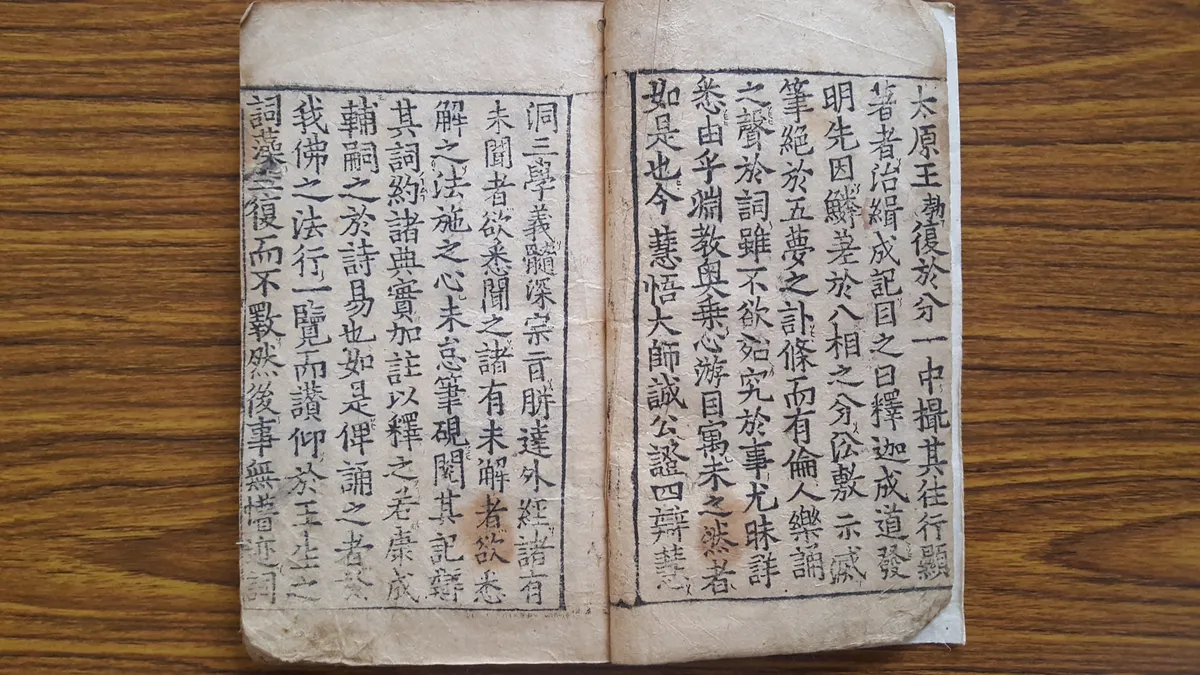
Hyeopjuseokgayeoraeseongdogi
夾註釋迦如來成道記
서울특별시 송파구
Basic information
- Designation
- Treasure No.2243
- Category
- Books & Records
- Era
- 1253년(고려 고종 40)
- Designated year
- 2024
- Location
- 송파구, 서울특별시— 서울특별시 송파구
- Coordinates
- 37.514584, 127.105918
AI Docent
Coming soonAn AI-generated, friendly retelling of this heritage site is available in Korean. An English version is on our roadmap — for now, please see the official description below.
Description
Machine-translatedThis English description was machine-translated and may contain inaccuracies. Refer to the original Korean text for details.
The 'Sutra of the Buddha's Life with Commentary (Xiechu Shijia Yulai Shengdaoji)' is a commentary work produced by Song Dynasty Master Hui-wu (慧悟大師) Dao-cheng (道誠) annotating the 'Sutra of Buddha Sakyamuni's Life' (石迦如來成道記) originally composed by Tang scholar Wang Bo (王勃). The work chronicles Buddha Sakyamuni from birth and growth through enlightenment to nirvana. This single-volume complete edition features a missing cover but otherwise maintains generally good preservation, with the main text containing early Joseon gugyeol (reading marks) and ink annotations indicating corrections and alternative character pronunciation marks. The work includes publication information stating 'Engraved at the Separate Tripitaka Printing Bureau (分司大藏都監) in the Gisi Year' (癸丑) in an empty space beneath the fascicle-end title, through which we can confirm creation from woodblocks carved by the Separate Tripitaka Printing Bureau in 1253 (King Gojong 40). The Main Tripitaka was completed in 1251 (King Gojong 38), with supplementary block printing (補板 editions) continuing through 1254 (King Gojong 41) by the Separate Tripitaka Printing Bureau to ensure complete production. Buddhist texts printed during this supplementary printing period are rarely confirmed, this work exemplifying such cases. Two surviving printed copies exist from the gold metal movable type editions of Eulhaeja type (을해자) cast during King Sejo's reign, but the designated copy represents the first confirmed edition in Korea and the sole existing example, possessing material completeness and rarity value. Furthermore, it enables additional confirmation of the existence and characteristics of Buddhist work projects conducted by the Separate Tripitaka Printing Bureau during the mid-13th century, serving as invaluable research material for this historical period.
Location
지도를 불러오는 중…
Have you visited this place?
Log in and verify your visit on-site via GPS to record a stamp in My Journey. (QR verification coming later.)
Images: KOGL (khs.go.kr) · Data source: Korea Heritage Service Open API (khs.go.kr)