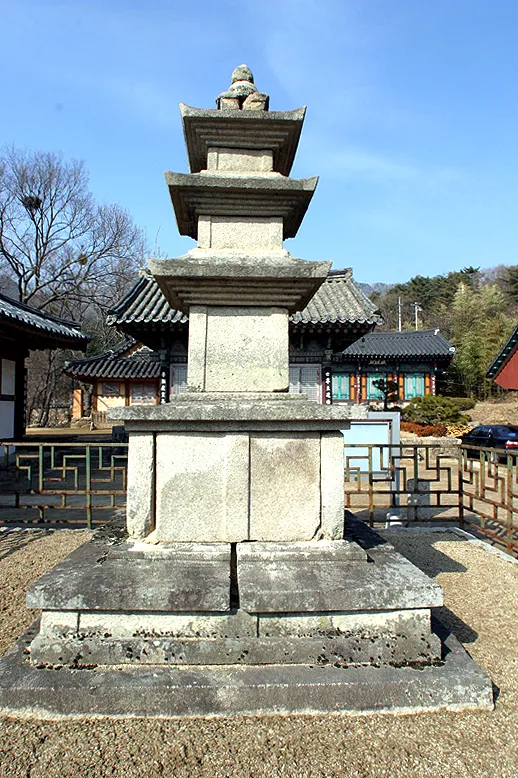
Three-story Stone Pagoda at Biroam Hermitage of Donghwasa Temple, Daegu
大邱 桐華寺 毘盧庵 三層石塔
대구광역시 동구
Basic information
- Designation
- Treasure No.247
- Category
- Sites & Pagodas
- Era
- 통일신라시대
- Designated year
- 1963
- Location
- 동구, 대구광역시— 대구광역시 동구 동화사1길 1(도학동, 동화사)
- Coordinates
- 35.991914, 128.702764
AI Docent
Coming soonAn AI-generated, friendly retelling of this heritage site is available in Korean. An English version is on our roadmap — for now, please see the official description below.
Description
Donghwasa Temple in Daegu was built by Geukdal in 493. This three-story stone Pagoda stands in front of Daejeokgwangjeon Hall, the main hall of Biroam Hermitage, which is considered part of the Donghwasa Temple. The pagoda is erected on a double-tiered stone base prepared on an earthen platform. The platform consists of a base, a three-storied main body and a capstone. The corner and central pillars are carved on the surfaces of the middle base which is made of a single stone, while each of the upper and lower bases are made up of four stone slabs. The body and the roof of each story are also made of a single stone block and decorated with the four-stepped cornice. The straight eaves are gently curved upward at all corners, as it’s the case in most of the stone pagodas made during the Silla period. The entire structure gradually decreases in size from bottom to top, creating a sense of balance and stability. Of the ornamental top portion, or finial, the lowest parts and over-turned bowl remain along with the sacred jewel. The use of multi-props to support each story and the upturned eaves indicate that it was made in the last years of the Silla Dynasty. Some of the reliquaries of Buddha were stolen during the repair work in 1966. But it was discovered from the inscription found on the inner surface of the reliquary that the pagoda was built in 863 (the third year of King Gyeongmun of Silla) in memory of King Minae.
Location
지도를 불러오는 중…
Have you visited this place?
Log in and verify your visit on-site via GPS to record a stamp in My Journey. (QR verification coming later.)
Images: KOGL (khs.go.kr) · Data source: Korea Heritage Service Open API (khs.go.kr)