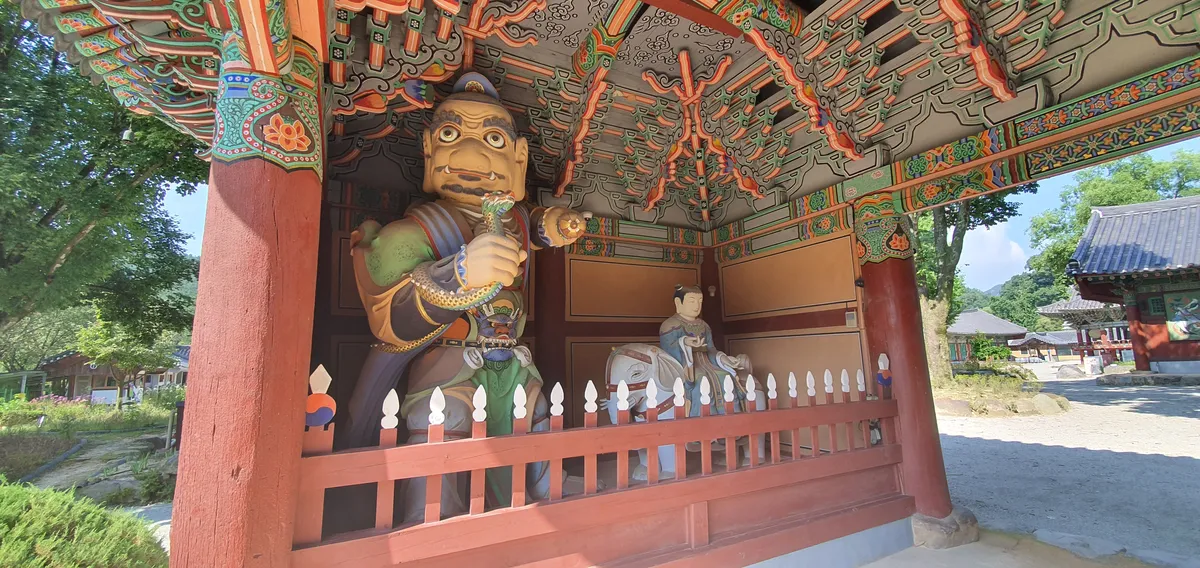
Songgwangsa Geumgang Gate, Wanju
完州 松廣寺 金剛門
전북특별자치도 완주군
Basic information
- Designation
- Treasure No.2251
- Category
- Architecture
- Era
- 조선시대
- Designated year
- 2024
- Location
- 완주군, 전북특별자치도— 전북특별자치도 완주군 송광수만로 255-16 (소양면, 송광사)
- Coordinates
- 35.885010, 127.242584Kakao address conversion
AI Docent
Coming soonAn AI-generated, friendly retelling of this heritage site is available in Korean. An English version is on our roadmap — for now, please see the official description below.
Description
Machine-translatedThis English description was machine-translated and may contain inaccuracies. Refer to the original Korean text for details.
Wanju Songkwang Temple's Vajra Gate (Geumgang-mun, also called Inwang-mun) lacks documented creation date. However, considering records including <Jeonju-bu Songkwang-sa Gaechang-ji Inscription (1636, Injo 14th year)>, <Songkwang-sa Beophang Chochang Sangsang Hwaju Deokrim (1665, Hyeonjong 6th year)>, and the confirmed 1649 (Injo 27th year) creation date of the Four Heavenly Kings sculptures, the gate is estimated to have been constructed prior to 1649. Notably, the sculptural cantilever forms closely parallel those of Songkwang's Daeungbojeon (principal Buddhist hall) and bell tower, both established during the seventeenth century and designated as Treasures, substantiating the historical-dating estimation. Within monastic complex layout designs, the sequential gate arrangement—single-pillar gate (iljumun), Vajra Gate (Geumgang-mun), and Four Heavenly Kings Gate (Sacheonwang-mun)—positioned along the central processional axis represents post-Imjin War temple-entrance temporal characteristics, exemplifying the era's architectural conventions. Notably distinctive, while typical monastic mountain gates (sanmun) employ column-head bracket or wing-bracket-style gable-roof configuration, Songkwang Temple's Vajra Gate uniquely adopts multiple-bracket-system hip-and-gable-roof design, demonstrating architectural originality. *The Vajra Gate, alternatively termed the Inwan Gate, features two "Vajra Force-Wielders" (Geumgang Ryeoksa) statues serving as protective guardians over Buddha-dharma (Buddhism) and monastic sanctum. The structural frame comprises 3-bay-front, 2-bay-side, five-rafter architecture. The bracket system employs three-bay exterior and four-bay interior outsets in multiple-bracket design, with all chim-cha (primary bracket members) configured in cross-shaped style. The outer bracket-series components feature upward-curved blade forms at initial through third bracket member levels and wing-bracket forms at the fourth level, with upward-curved roof-support forms at the fifth level, exemplifying post-mid-Joseon architectural styling. Additionally, the eave-end lower-section interior-support composition employs old-style reinforcement methodology, with the central-bay interior cantilever support structure representing uncommon load-bearing technique for three-bay structures requiring hip-and-gable-roof configuration. This represents an exceptionally rare old-style technique, conferring high scholarly value. The internal beam-end configuration utilizes old-style three-part-carved design technique executed with reserve, with bracket member positioning arranged to transfer roof-load effectively through column systems. This distinctive methodological approach demonstrates uncommon technical sophistication in old-style architectural design, meriting exceptional scholarly appreciation for Wanju Songkwang Temple's Vajra Gate architectural achievement.
Location
지도를 불러오는 중…
Have you visited this place?
Log in and verify your visit on-site via GPS to record a stamp in My Journey. (QR verification coming later.)
Images: KOGL (khs.go.kr) · Data source: Korea Heritage Service Open API (khs.go.kr)