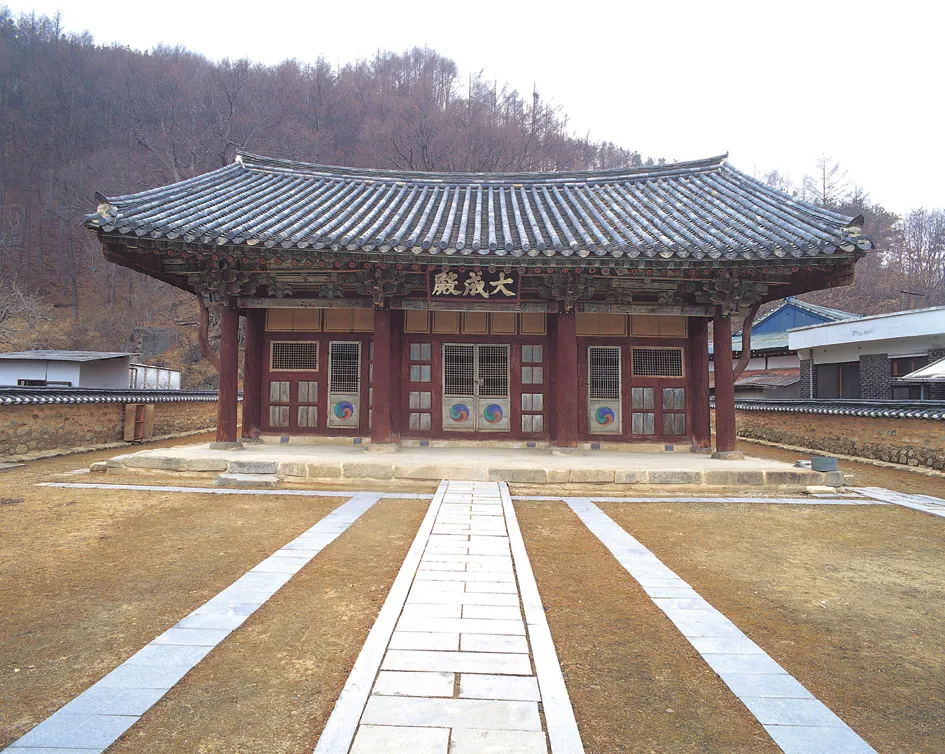
Daeseongjeon Shrine of Jangsuhyanggyo Local Confucian School
長水鄕校 大成殿
전북특별자치도 장수군
Basic information
- Designation
- Treasure No.272
- Category
- Architecture
- Era
- 조선 태종 7년(1407)
- Designated year
- 1963
- Location
- 장수군, 전북특별자치도— 전북 장수군 장수읍 향교길 31-14 (장수리)
- Coordinates
- 35.648472, 127.523252
AI Docent
Coming soonAn AI-generated, friendly retelling of this heritage site is available in Korean. An English version is on our roadmap — for now, please see the official description below.
Description
Jangsuhyanggyo Local Confucian School was established in 1407 (the 7th year of the reign of King Taejong) for the purpose of holding memorial services for men of virtue and educating local people. The school was relocated to the current site in 1686 (the 12th year of the reign of King Sukjong). The Daeseongjeon Hall is a single story building where memorial services for Confucius and other famous Confucian scholars are held. It measures three kan (a unit of measurement referring to the distance between two columns) at the front and two kan at the sides under a gable roof. This normal-sized building has hinged doors for all the three rooms, while side rooms have a rectangular paper window in the corner. The pieces of wood, or gongpo (inserted between the rafter and column) supporting the eaves and transferring the weight of the roof and the structure below are also finely decorated. This type of decoration is more apparent in the architectural style of the late Joseon Dynasty. The Jangsuhyanggyo Local Confucian School survived the Japanese Invasion of Korea, during which period a countless number of Confucian schools were burnt down, making it an important source of study on the history of Confucian schools in the early Joseon Dynasty. The books kept here are also valuable materials for studying the history of local community. Overall, the Daeseongjeon Hall, is regarded as a representative architecture of the Joseon Dynasty.
Location
지도를 불러오는 중…
Have you visited this place?
Log in and verify your visit on-site via GPS to record a stamp in My Journey. (QR verification coming later.)
Images: KOGL (khs.go.kr) · Data source: Korea Heritage Service Open API (khs.go.kr)