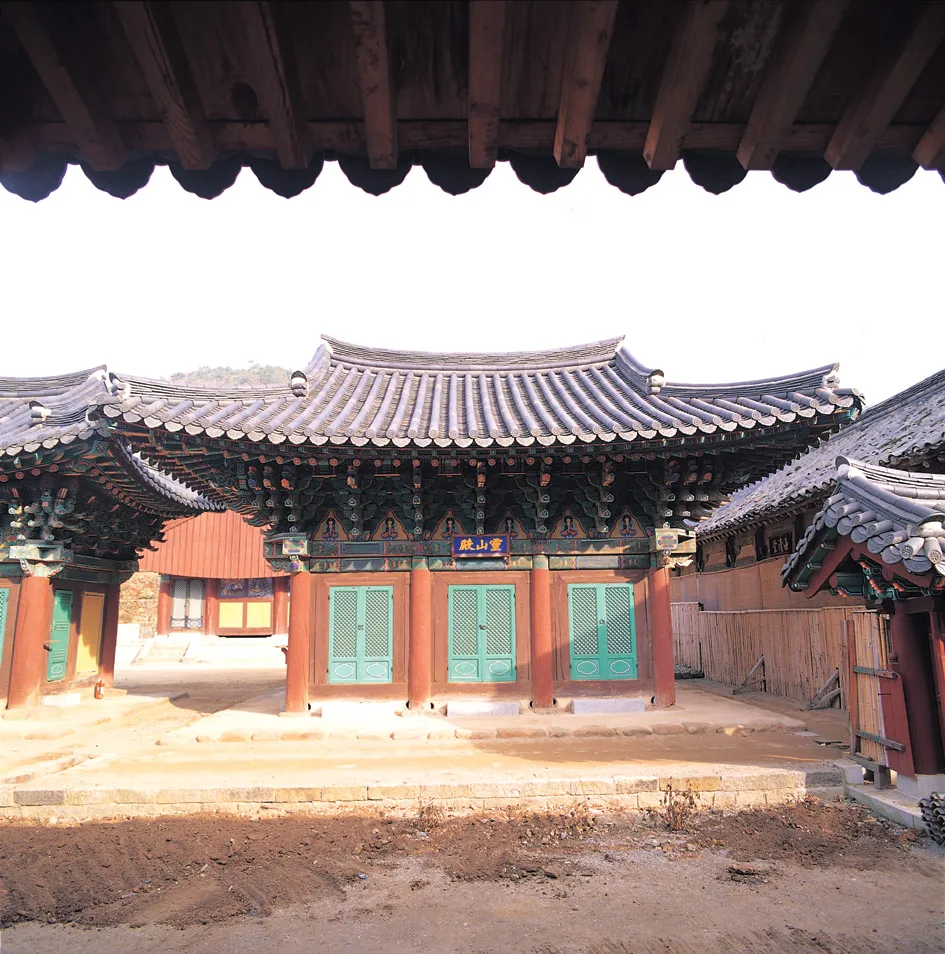
Yeongsanjeon Hall of Songgwangsa Temple, Suncheon
順天 松廣寺 靈山殿
전라남도 순천시
Basic information
- Designation
- Treasure No.303
- Category
- Architecture
- Era
- 조선시대 중기
- Designated year
- 1963
- Location
- 순천시, 전라남도— 전남 순천시 송광면 송광사안길 100, 송광사 (신평리) / (지번)전남 순천시 송광면 신평리 12 송광사
- Coordinates
- 35.001721, 127.275844
AI Docent
Coming soonAn AI-generated, friendly retelling of this heritage site is available in Korean. An English version is on our roadmap — for now, please see the official description below.
Description
Songgwangsa Temple, located in Jogyesan Mountain, is one of three major temples in Korea. The name originated from Songgwangsan, the old name of Jogyesan Mountain. There is no precise record saying when the temple was built, but there is a record that it was constructed by Chejing in late Silla. According to the record of the temple, this hall was built in 1639, the 17th year of the reign of King Injo, and repaired in 1736, the 12th year of the reign of King Yeongjo. The current building was repaired in 1973. Yeongsanjeon Hall is enshrined with a Buddha statue and has a palsangdo, a picture depicting the life of Buddha in 8 stages. There is also a picture of yeonsandaehoe, depicting a sermon of Buddha, together with a Buddha statue. The hall consists of 3-kan (a unit of measurement referring to the distance between two columns) front space and 2-kan side space. It has a hip and gable roof called paljakjibung. The brackets which support the eaves of the roof are set up not only on the pillars but also between them. This is called dapo (multiple column-heads) style. Despite its small size, the column-heads are assembled and raised in a heavy tone. It is thought that there was an intention to project a solemn exterior. The detailed technique of making the column-heads shows the strong, simple characteristics of the early Joseon Dynasty. Even though it is small and stands on a small site, it is a beautiful building and is an important asset for research in construction history.
Location
지도를 불러오는 중…
Have you visited this place?
Log in and verify your visit on-site via GPS to record a stamp in My Journey. (QR verification coming later.)
Images: KOGL (khs.go.kr) · Data source: Korea Heritage Service Open API (khs.go.kr)