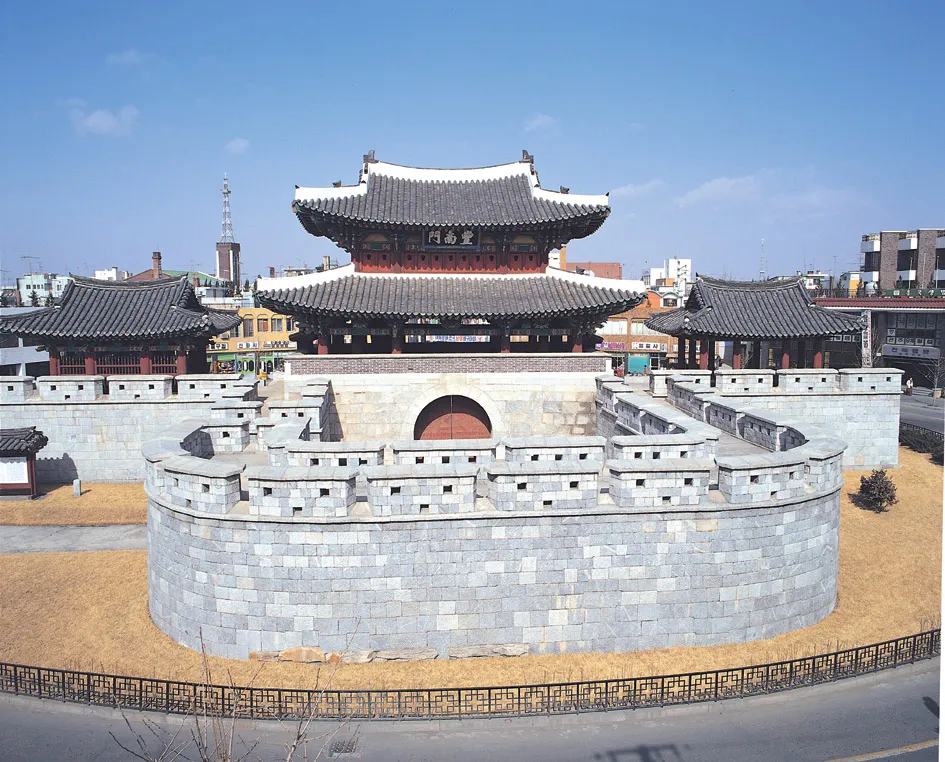
Pungnammun Gate, Jeonju
全州 豐南門
전북특별자치도 전주시
Basic information
- Designation
- Treasure No.308
- Category
- Architecture
- Era
- 조선시대 후기
- Designated year
- 1963
- Location
- 전주시, 전북특별자치도— 전북 전주시 완산구 풍남문3길 1 (전동)
- Coordinates
- 35.813510, 127.147577
AI Docent
Coming soonAn AI-generated, friendly retelling of this heritage site is available in Korean. An English version is on our roadmap — for now, please see the official description below.
Description
This was the southern gate of Jeonjueupseong and was called Myeonggyeonnu when the fortress walls and gate had been rebuilt in 1734, the 10th year of the reign of King Yeongjo, following the destruction caused by the second Japanese Invasion of Korea in 1597, the 30th year of the reign of King Seonjo. It was burnt down in 43rd year of King Yeongjo’s reign and was rebuilt and renamed Pungnammun Gate by Hong Nak-in in the following year (1768). As the fortress walls and gate were removed following urban renovation during the period of King Sunjong, the Pungnammun Gate was much impaired. The present gate had its old shape restored by a three-year period of work from 1978. It consists of 3-kan (a unit of measurement referring to the distance between two columns) front space and 3-kan side space on the first floor and 3-kan front space and 1-kan side space on the second floor. It has a hip and gable roof called paljakjibung. The gongpo (column-heads) that supports the eaves of the roof is set up only on the pillars. This is called jusimpo style of building. A special thing is that the width of the 2nd floor is suddenly reduced compared to that of 1st floor. This is because the pillars of the 1st floor continue up to the 2nd floor where they are used as the corner pillars, a rare style in the construction of gate tower in Korea. The carved shape of the column-heads and the dragons carved on the pillars between compartments in the middle of the 1st story are characteristics of construction in late Joseon, which used an abundance of decoration. This is an important cultural asset for researching the construction of old gate tower.
Location
지도를 불러오는 중…
Have you visited this place?
Log in and verify your visit on-site via GPS to record a stamp in My Journey. (QR verification coming later.)
Images: KOGL (khs.go.kr) · Data source: Korea Heritage Service Open API (khs.go.kr)