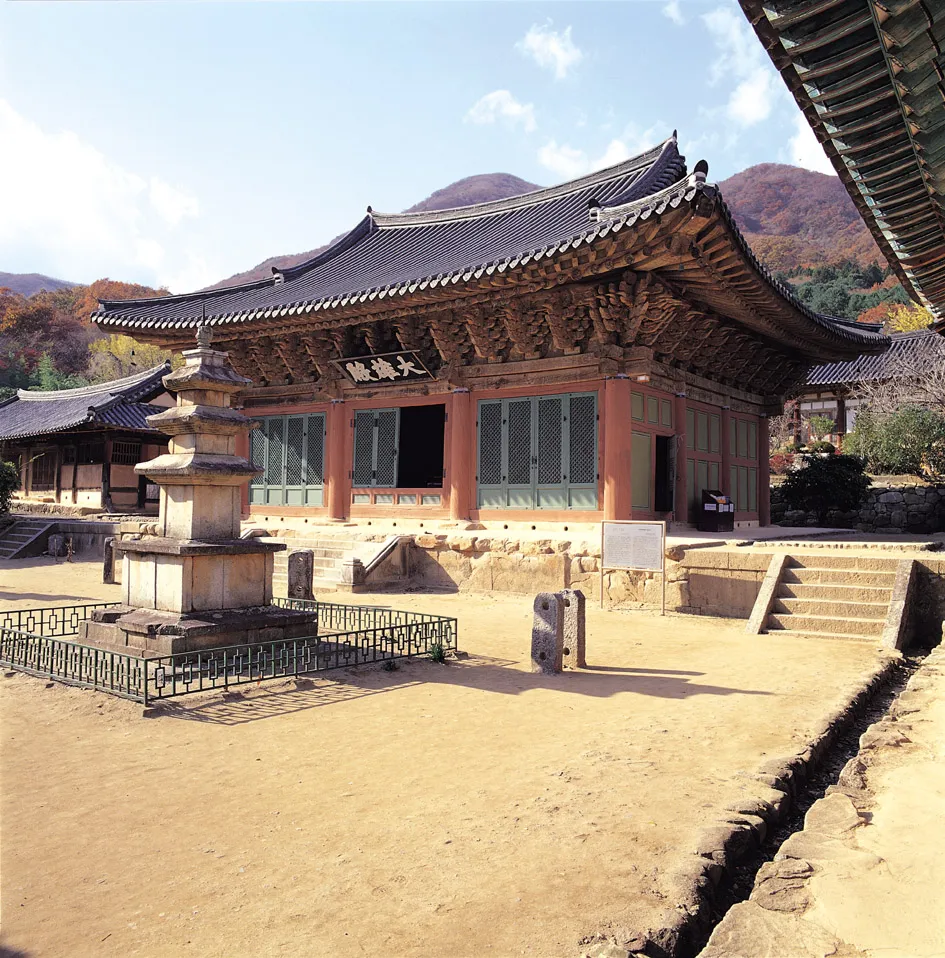
Daeungjeon Hall of Seonamsa Temple, Suncheon
順天 仙巖寺 大雄殿
전라남도 순천시
Basic information
- Designation
- Treasure No.1311
- Category
- Architecture
- Era
- 조선 후기
- Designated year
- 2001
- Location
- 순천시, 전라남도— 전남 순천시 승주읍 선암사길 450 (죽학리) / (지번)전남 순천시 승주읍 죽학리 802
- Coordinates
- 34.996545, 127.331097
AI Docent
✨ AI-generatedWelcome to Daeungjeon Hall, the Main Hall of Seonamsa Temple! Imagine stepping into a building that has stood for nearly 200 years, rebuilt in 1824 during Korea's Joseon Period. This hall is a masterpiece of late Joseon architecture, and it's easy to see why. Look closely at the columns—they're wider at the base and taper toward the top, a sophisticated design technique. Notice the ornamental dragon heads adorning the column tops and the lotus bud carvings inside. Every detail reflects the gorgeous craftsmanship of that era. The hall enshrines a Buddha image and anchors the temple complex alongside the nearby Manseru Hall. Outside, three stone pagodas stand in the front yard, adding to the sacred atmosphere. What makes this special? The building survived destruction and was painstakingly rebuilt, preserving authentic late Joseon architectural style. When you stand here, you're experiencing centuries of Korean Buddhist heritage and artistic skill in one remarkable structure.
⚠ This is an AI-generated retelling of the official description. For accuracy, refer to the official description below.
Description
Seonamsa Temple in Jogyesan Mountain, named Biroam by Monk Ado in 529 (the 7th year of the reign of King Seong of Baekje), was renamed Seonamsa by State Preceptor Doseon in 875 (the 5th year of the reign of King Heongang of Unified Silla). Later, it became a well-known temple with the help of Monk Uicheon (aka Uigakguksa) during the Goryeo Period (918-1392). The Main Hall of the temple was destroyed by fire during the Japanese invasion in (1597) and rebuilt in 1660 (the first year of King Hyeonjong’s reign). It was destroyed again in 1766 (the 42nd year of King Yeongjo’s reign) and rebuilt in 1824 (the 24th year of King Sunjo’s reign). The Main Hall enshrines a Shakyamuni Buddha image. Along with nearby Manseru Hall, it is a central part of the temple. In the front yard are three-tiered stone pagodas (Treasure No. 395) standing side by side. The main hall (measuring 3 kan* by 3 kan) has minheullim columns (narrower at the top than at the base) supported by natural cornerstones. The top of the columns is adorned with dragon head-shaped ornaments. The building, which has a hip and gable roof with gongpo designed to hold up the roof's eaves on a pillar, is set up not only on the pillars but also between them. The interior structure is finished with lotus bud-shaped ornaments, displaying the gorgeous and ornamental techniques of the late Joseon Period (1392-1910). The building is deemed academically and historically valuable since it showcases the architectural style prevalent in the later Joseon Period when it was renovated. (*kan: a unit of measurement referring to the distance between two columns)
Location
지도를 불러오는 중…
Have you visited this place?
Log in and verify your visit on-site via GPS to record a stamp in My Journey. (QR verification coming later.)
Images: KOGL (khs.go.kr) · Data source: Korea Heritage Service Open API (khs.go.kr)