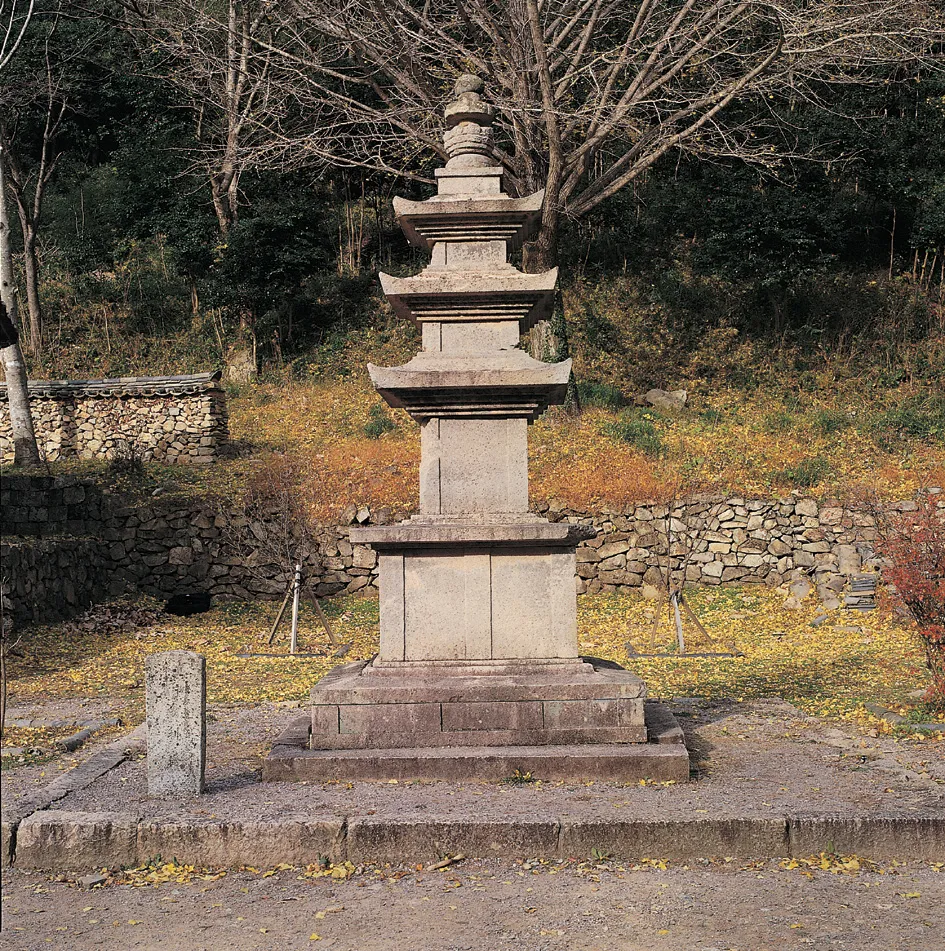
Three-story Stone Pagoda of Daeheungsa Temple, Haenam
海南 大興寺 三層石塔
전라남도 해남군
Basic information
- Designation
- Treasure No.320
- Category
- Sites & Pagodas
- Era
- 통일신라시대
- Designated year
- 1963
- Location
- 해남군, 전라남도— 전남 해남군 삼산면 대흥사길 400, 대흥사 (구림리) / (지번)전남 해남군 삼산면 구림리 823, 산8-1
- Coordinates
- 34.477251, 126.617159
AI Docent
✨ AI-generatedWelcome to the Three-story Stone Pagoda of Daeheungsa Temple! This elegant structure stands in front of Eungjinjeon Hall, representing the very best of Unified Silla craftsmanship. Built in the late Unified Silla period, this pagoda is constructed from individual stones—each level carved as a single piece with remarkable precision. Notice the distinctive pillar patterns etched across the main stones and the thick, graceful eaves. What makes this pagoda truly special? It houses sacred relics of Sakyamuni Buddha, brought from China by the renowned Buddhist Monk Jajang. In 1967, workers discovered a beautiful gilt-bronze Buddha statue hidden within the upper structure—a treasure that had been protected for centuries. Daeheungsa Temple itself has a remarkable history, expanded by Sesan, one of Korea's greatest Buddhist monks, after the turbulent Japanese Invasion of 1592. This pagoda, alongside its sister structure at Bungmireukam Hermitage, shows how Silla's artistic vision spread throughout the southwestern region. Come experience this timeless masterpiece in person.
⚠ This is an AI-generated retelling of the official description. For accuracy, refer to the official description below.
Description
There are records saying that Daeheungsa Temple was built in 426 by Jeongwan, a Silla Buddhist monk of eminent virtue, and called Maniram Hermitage, and others saying that it was one of the 500 temples which the Buddhist Monk Doseon encouraged to build after he came back from Tang Dynasty China. The temple was expanded by Sesan, one of the greatest Buddhist monks in Korea, following the Japanese Invasion of Korea in 1592. This pagoda stands in front of Eungjinjeon Hall of Daeheungsa Temple. It preserves sarira of Sakyamuni which was carried by Buddhist Monk Jajang of Silla from China. It is a typical Silla stone pagoda, consisting of a three-story body on a two-story stylobate. The upper and the lower stylobates are engraved with pillar patterns in the four edges and in the middle of the four sides. The main stones and roof stones of the body are each made of one stone. Pillar patterns are conspicuously engraved on each main stone. The main stone of the first story is far higher than those of the other stories. The roof stones have thick eaves and four-tiered bases. The final base, which is big enough to look like a body stone, an over-turned bowl, a lotus flower shaped stone and a wheel shaped decoration are laid over the top of the pagoda. Overall, the pagoda shows elegant carving skill. In 1967, while the pagoda was being repaired, a Gilt-bronze standing Buddha was discovered in its upper stylobate. This pagoda has a simplified form of Unified Silla, but judging from the fact that the number of center pillars on the stylobate decreased and the roof stones have four-tiered base, it is presumed to have been built in the late Unified Silla. Along with the Three-story Stone Pagoda of Bungmireukam Hermitage of Daeheungsa Temple in Haenam, it is an important structure which indicates that the pagoda style of Unified Silla spread to the southwestern area.
Location
지도를 불러오는 중…
Have you visited this place?
Log in and verify your visit on-site via GPS to record a stamp in My Journey. (QR verification coming later.)
Images: KOGL (khs.go.kr) · Data source: Korea Heritage Service Open API (khs.go.kr)