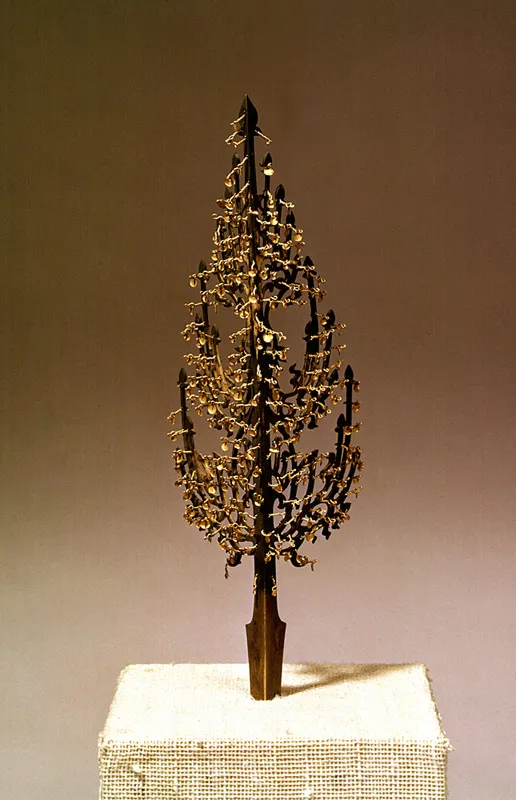
Reliquaries from the Five-story Brick Pagoda of Songnimsa Temple, Chilgok
漆谷 松林寺 五層塼塔 舍利莊嚴具
대구광역시 수성구
Basic information
- Designation
- Treasure No.325
- Category
- Craft
- Designated year
- 1963
- Location
- 수성구, 대구광역시— 대구 수성구 청호로 321, 국립대구박물관 (황금동,국립대구박물관)
- Coordinates
- 35.845859, 128.637925
AI Docent
Coming soonAn AI-generated, friendly retelling of this heritage site is available in Korean. An English version is on our roadmap — for now, please see the official description below.
Description
Songnimsa Temple was built in the fifth year of the reign of King Jinheung of Silla in order to enshrine the Buddha's sarira which was brought from China by Buddhist Monk Myeonggwan. In this temple, there is a five-story brick pagoda (Treasure No. 189), one of the rare brick pagodas remaining in Korea. When it was dismantled for repair in 1959, many relics were found inside. In the first story, there were two wood, two stone, and two bronze Buddha statues. In the second story, there were remains from the Silla Dynasty, which are the most notable. These were a gilt-bronze stupa which was made of thin gold plate with delicate decoration, a long-necked sarira bottle made of green glass, and glasses with jade and pearls attached. These were in a tortoise-shaped stone case. In the third story, there was a stone box with a wooden lid that contained some decomposed papers. The over-turned bowl on the roof stone of the fifth story contained a round-shaped inlaid celadon case and two gilt-bronze ear ornaments. The inlaid celadon case is decorated with chrysanthemums and vine patterns. In view of the pattern and the glaze, it is an outstanding work of the late 12th century, the time of the flourishing of inlaid celadon. In addition, there were 281 beads, 15 silver rings, 7 aromatic woods, and one seed of a boa tree. Considering the fact that various remains of United Silla and Goryeo are found in one pagoda, it is clear that there have been several periods of repair. The gilt-bronze stupa and sarira bottle in the tortoise-shaped box are rare, and valuable as historic material.
Location
지도를 불러오는 중…
Have you visited this place?
Log in and verify your visit on-site via GPS to record a stamp in My Journey. (QR verification coming later.)
Images: KOGL (khs.go.kr) · Data source: Korea Heritage Service Open API (khs.go.kr)