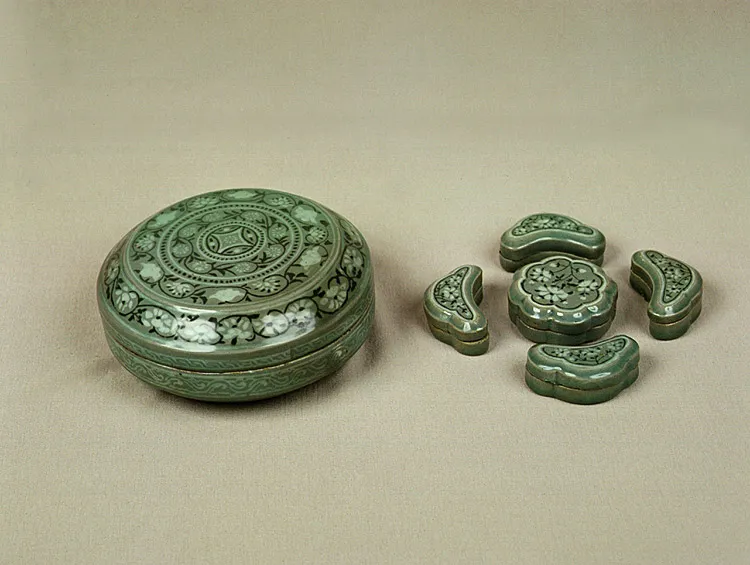
Celadon Lidded Bowl Set with Inlaid Chrysanthemum, Peony, and Scroll Design
靑磁 象嵌菊花牡丹唐草文 母子盒
서울특별시 성북구
Basic information
- Designation
- Treasure No.349
- Category
- Craft
- Era
- 고려시대(12세기)
- Designated year
- 1963
- Location
- 성북구, 서울특별시— 서울특별시 성북구 성북로 102-11 (성북동, 간송미술관)
- Coordinates
- 37.589116, 127.018215
AI Docent
Coming soonAn AI-generated, friendly retelling of this heritage site is available in Korean. An English version is on our roadmap — for now, please see the official description below.
Description
The process of making inlaid celadon ceramics in Goryeo was first, to make a bowl out of clay and half dry it, second, to engrave a pattern or picture on the surface, third, to fill in the line with white clay or sandy soil, and fourth, to spread glaze and bake. The technique, by which a black and white pattern is visible through celadon enamel, appeared in the first half of 12th century and had its golden age in the mid 12th century. This bowl, which is believed to have been used to keep cosmetics, consists of one mohab (the outside biggest bowl) and 5 jahab (the small bowls set inside). Jahab are composed of one round octagonal bowl (height 3.1cm, diameter 7.9cm) laid in the center, and four mountain-shaped bowls (height 3cm, depth 7.8cm) set around it. On the lid, a peony pattern is inlaid in black and white while the outside brim is decorated with a white inlaid lighting pattern. The mohab is 8.4 cm in height and 19.1 cm in diameter. The brim of its lid is decorated with a peony and chrysanthemum pattern and in the center of the lid a chrysanthemum is inlaid in black and white. The body of the mohab is finished with a vine pattern. Such a mojahab (combined mohab and jahab) can be found similarly in a fragment from a celadon kiln in Yucheon-ri, Boan-myeon, Buan-gun, Jeollabuk-do.
Location
지도를 불러오는 중…
Have you visited this place?
Log in and verify your visit on-site via GPS to record a stamp in My Journey. (QR verification coming later.)
Images: KOGL (khs.go.kr) · Data source: Korea Heritage Service Open API (khs.go.kr)